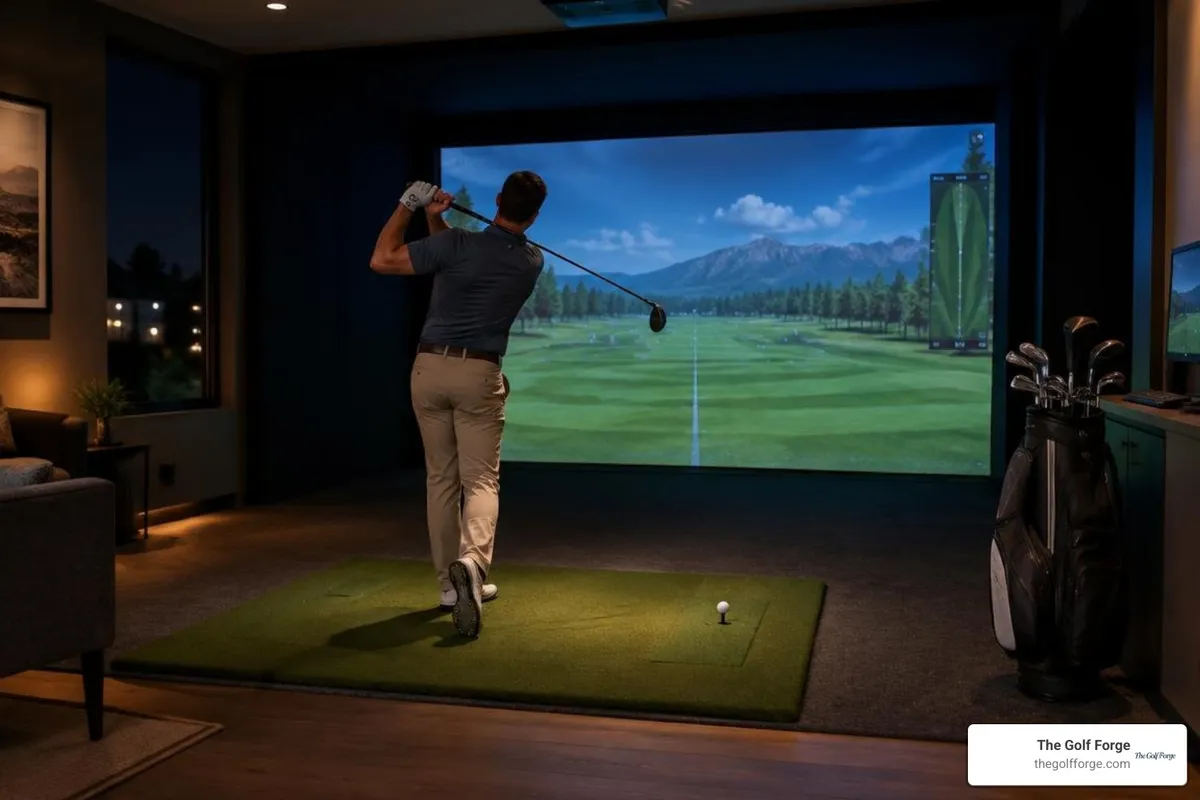
best golf simulators for business

Swing Into Profit with the Best Golf Simulators for Your Business

June 08, 202611 min read

The Indoor Golf Business Boom: Why Choosing the Right Simulator Matters

If you're researching the best golf simulators for business, here's a quick summary of the top options:

Simulator Best For Price Range TrackMan iO Premium bars, high-end venues $$$$ Uneekor EYE XO2 Multi-use commercial spaces $$$ Golfzon TwoVision NX Immersive entertainment venues $$$$ Foresight Falcon Performance centers, training facilities $$$ TruGolf MAX Turnkey commercial setups $$ - $$$$

Golf simulator businesses are popping up everywhere — in downtown bars, country clubs, sports complexes, and luxury apartment amenities. And it makes sense. Indoor golf solves a real problem: golfers want to practice and play year-round, regardless of weather.

The economics are compelling too. A well-run simulator bay generates direct revenue from hourly rentals and memberships, plus it lifts the entire business through increased food and beverage spending.

But not all simulators are built for the demands of a commercial environment. The wrong choice can mean expensive downtime, frustrated customers, and hardware that wears out fast.

The stakes are high. One commercial impact screen manufacturer reported over 200,000 golf ball shots in a single year without needing a replacement — but only because it was built for commercial-grade volume. Consumer-grade equipment simply doesn't hold up.

This guide compares the top commercial golf simulator systems available in 2026, so you can choose the right setup for your business goals, space, and budget.

Commercial golf simulator business model infographic showing revenue streams, space requirements, and key system tiers

What Makes a Golf Simulator Commercial-Grade?

When transitioning from a residential setup to a business environment, the definition of "quality" changes completely. A home simulator might see three to five hours of use per week. A commercial simulator in a bustling venue can easily face eight to twelve hours of continuous, high-volume use every single day.

So, what separates a consumer model from a true commercial-grade system?

1. Industrial-Grade Durability

Commercial setups require heavy-duty components designed to handle constant impacts. This begins with the impact screen. Premium commercial screens, like the SIGPRO Premium screen, are engineered with multi-layer spacer mesh to absorb high-velocity ball impacts while minimizing noise and bounce-back. A standard screen will sag or tear within months under commercial volume, whereas a commercial-grade screen can withstand hundreds of thousands of shots.

Enclosures must also feature heavy-duty steel or aluminum frames and thick, padded canvas side panels. This protects your facility's walls, ceiling, and lighting from stray shots (and trust us, your customers will hit plenty of stray shots).

2. High-Performance Hitting Mats

In a business setting, a standard turf mat will quickly wear down, leaving a permanent depression where golfers stand and strike the ball. Commercial hitting surfaces use thick, shock-absorbing foam bases combined with realistic synthetic turf fibers. These mats must withstand continuous iron strikes, heavy outdoor footwear, and aggressive golf swings without tearing or causing joint fatigue for your customers.

3. Overhead, Out-of-Way Launch Monitors

While portable, floor-mounted launch monitors are great for individual practice, they are a liability in a commercial environment. Floor-based units can easily be struck by a club, kicked by a customer, or stolen. Furthermore, floor units require manual adjustment when switching between left-handed and right-handed players.

Commercial-grade systems almost exclusively utilize ceiling-mounted launch monitors. This keeps your expensive tracking technology safe from accidental damage and ensures a seamless experience for groups with mixed-handed players.

To explore how these industrial-grade components come together to deliver an elite playing experience, check out our indoor golf services.

Comparing Tracking Technologies for Business Environments

Choosing the right tracking technology is the most critical technical decision you will make. The technology you select dictates your space requirements, your lighting needs, and the overall accuracy of the gameplay.

Tracking Technology How It Works Best For Pros Cons Space Requirements Radar (Microwave) Emits radio waves to track ball flight and spin. Outdoor-to-indoor setups, dedicated training. Exceptional ball tracking over long distances. Needs significant room depth; sensitive to metallic interference. Deepest depth required (often 18-22+ feet). Photometric (Camera) High-speed cameras capture images of the ball at impact. Indoor bays, tight spaces, club fitting. Highly accurate spin data; works in smaller rooms. Needs consistent lighting; floor units can be hit by clubs. Compact depth (15-16 feet is usually sufficient). Overhead / Hybrid Ceiling-mounted dual-camera/infrared sensors. Multi-user commercial bays, indoor golf bars. Safe from damage; instant left/right play; large hitting zone. Higher upfront cost; requires professional mounting. Moderate depth; requires fixed ceiling height (9-10+ feet).

Radar Tracking Systems

Radar systems track the ball by measuring the Doppler shift of reflected radio waves. While legendary for outdoor tracking, radar systems in commercial indoor environments require a substantial amount of space behind the screen and behind the golfer to accurately read ball flight and spin. If your commercial space has limited depth, radar may struggle to capture clean data.

Photometric (Camera-Based) Systems

Photometric systems use ultra-high-speed cameras to take thousands of pictures of the ball immediately after impact. This allows them to measure ball speed, launch angle, and spin axis with incredible precision. Because they only need to see the ball for the first few inches of travel, camera-based systems require significantly less room depth.

Overhead Sensors

For commercial businesses, overhead camera systems (often paired with infrared sensors) are the gold standard. They offer a massive, continuous hitting zone. Customers don't have to worry about placing the ball on an exact, tiny dot on the mat; they can simply drop the ball and swing.

The Best Golf Simulators for Business in 2026

Investing in a commercial system means buying a complete ecosystem: the launch monitor, the enclosure, the projector, the computing power, and the software.

Many business owners opt for turnkey commercial packages to ensure all components are fully compatible and professionally supported. To browse complete commercial systems and customizable options, you can research Commercial Golf Simulators for Businesses.

Below are the standout commercial systems dominating the market in 2026.

TrackMan iO: The Best Golf Simulators for Business in the Premium Tier

TrackMan has long been the gold standard for PGA Tour professionals, and the TrackMan iO brings that elite reputation into indoor commercial facilities. Designed specifically for indoor use, the TrackMan iO is a ceiling-mounted unit that combines high-speed optical camera tracking with dual-radar technology.

  • Why it's great for business: The TrackMan brand carries immense prestige. Golfers actively seek out facilities equipped with TrackMan. The system features a highly intuitive user interface, incredibly fast processing times, and robust league play capabilities.

  • Best suited for: Premium sports bars, high-end entertainment venues, and country clubs looking to offer a top-tier amenity.

Uneekor EYE XO2: The Best Golf Simulators for Business for Multi-Use Commercial Spaces

Uneekor has established itself as an absolute powerhouse in the commercial indoor golf space. The EYE XO2 is a ceiling-mounted system utilizing three high-speed cameras and infrared sensors to capture detailed club and ball data.

  • Why it's great for business: The EYE XO2 features one of the largest hitting zones on the market (measuring 28" x 21"), meaning players don't have to fuss with ball placement. It integrates seamlessly with GSPro, the industry's most popular third-party simulator software, as well as Uneekor’s own Refine+ software. It is a highly reliable, low-maintenance workhorse.

  • Best suited for: Multi-bay commercial facilities, indoor golf centers, and training academies.

Golfzon TwoVision NX: The Ultimate Immersive Experience

If your business goal is to create the most realistic, "wow-factor" entertainment experience possible, the Golfzon TwoVision NX is in a class of its own.

  • Why it's great for business: This system is powered by Unreal Engine 5, delivering jaw-dropping, lifelike graphics. It features an upgraded motion swing plate that actually tilts and adjusts to mimic the real-world slopes of the course you are playing. Additionally, it offers five distinct hitting surfaces (fairway, rough, and sand) and an auto-tee system that automatically collects and tees up the ball for the player.

  • Best suited for: High-end sports lounges and luxury entertainment centers where user immersion is the primary revenue driver. Learn more about this premium system by viewing the Golfzon TwoVision NX Simulator.

Foresight Falcon: Ceiling-Mounted Precision

Foresight Sports is legendary for its camera-based launch monitors (such as the GCQuad). The Foresight Falcon takes that same tour-level photometric accuracy and packages it into a rugged, ceiling-mounted design built specifically for high-volume commercial use.

  • Why it's great for business: The Falcon features a massive hitting zone and connects directly to Foresight’s FSX software suite, which is perfect for both serious game improvement and casual gaming. Its reinforced undercarriage is built to withstand any accidental high-lofted ball strikes, making it exceptionally durable.

  • Best suited for: Dedicated golf instruction facilities, high-volume simulator bars, and serious training environments.

Maximizing ROI: Revenue Models and Space Requirements

Investing in the best golf simulators for business is only half the equation; you also need to design a space that maximizes earning potential.

Busy indoor golf lounge with multiple active simulator bays

Space Requirements

Before signing a lease on a commercial space, you must ensure the physical layout can accommodate your simulator bays. While some systems claim to fit in smaller spaces, we recommend the following minimum and ideal dimensions for a safe, comfortable commercial bay:

  • Minimum Dimensions: 13’W x 16’D x 9’H

  • Ideal Dimensions: 15’W x 20’D x 10’H

Having a 10-foot ceiling height is crucial. It prevents taller golfers from feeling restricted during their backswing and protects your ceiling from driver impacts. A 15-foot width allows you to center the hitting mat, accommodating both left- and right-handed players without needing to shift any equipment.

Revenue Models for Commercial Success

To build a highly profitable indoor golf business, we recommend diversifying your revenue streams:

  1. Hourly Rentals: The foundation of most indoor golf businesses. Rates typically range from $40 to $80+ per hour depending on the time of day and week.

  2. Memberships: Drive predictable monthly recurring revenue (MRR) by offering tiered membership options. This keeps your bays active during slower weekday morning hours. Learn more about structuring these options by viewing our Membership program.

  3. Corporate Events & Parties: High-margin private rentals for corporate team-building, holiday parties, and local events. Discover how we cater to business clients through our specialized Corporate Membership packages.

  4. Food & Beverage Uplift: If your venue serves food and drinks, simulators act as an incredible customer magnet. Groups renting a bay for 2–3 hours will naturally spend heavily on food and beverages during their session.

The Utah Local Scene

If you are operating in Utah—specifically around South Jordan, West Jordan, or Sandy—the local demand for indoor golf is massive. Long, cold winters and hot summer afternoons make indoor golf an incredibly appealing year-round activity.

Local businesses in the Salt Lake Valley utilize various models, from hourly entertainment lounges to structured training centers. By offering high-quality, reliable bays, you can capture a loyal customer base of local golfers looking to keep their game sharp year-round.

Frequently Asked Questions about Commercial Golf Simulators

How much space is required for a commercial golf simulator?

For a safe and comfortable commercial setup, we recommend a space that is at least 15 feet wide, 20 feet deep, and 10 feet high. While you can technically squeeze a simulator into a room with a 9-foot ceiling, players will often feel restricted, and you run a much higher risk of clubs striking the ceiling or overhead equipment.

What are the typical startup and ongoing costs for a simulator business?

A commercial-grade simulator package (enclosure, impact screen, commercial hitting mat, ceiling-mounted launch monitor, projector, and high-performance PC) typically ranges from $15,000 to $36,000+ per bay.

Ongoing costs include software subscriptions (such as GSPro or FSX Play, which range from $250 to $1,000+ annually per bay), commercial liability insurance, electricity, and periodic hardware maintenance (like replacing projector bulbs or worn hitting turf).

How long do commercial impact screens last under heavy use?

Under heavy commercial use, a high-quality, multi-layer impact screen will typically last between 100,000 to 200,000 shots before showing signs of wear or losing its tension. To maximize screen lifespan, ensure your customers use clean, unmarked golf balls (sharpie marks and dirt will transfer to the screen and cause premature wear) and avoid using golf clubs with sharp edges or burrs.

Conclusion

Starting or expanding an indoor golf business is an incredible opportunity to tap into a passionate, high-spending market. However, success relies heavily on choosing the right hardware. By investing in commercial-grade durability, choosing overhead tracking systems, and designing spacious, inviting bays, you can ensure your business remains highly profitable and keeps customers coming back.

At The Golf Forge, we operate state-of-the-art indoor golf training facilities in Utah, featuring locations in South Jordan and West Jordan. Our private, 24/7-accessible bays are equipped with advanced Foresight launch-monitor technology, providing golfers with consistent, data-driven practice and play.

Whether you are looking to sharpen your own game or experience a premier commercial simulator setup in action, we invite you to visit us. Ready to experience the future of indoor golf? Book Now and take your first swing, or explore how we can help you start your indoor golf journey with our professional services.

Back to Blog