

Everything You Need to Know About Golf Launch Monitors
What Is a Golf Launch Monitor — and Do You Need One?
A golf launch monitor is a device that measures your ball flight and swing data in real time, giving you instant feedback on every shot you hit.
Quick answer: Here are the most important things to know:
What it does: Tracks metrics like ball speed, clubhead speed, launch angle, spin rate, and carry distance
Who it's for: Golfers who want data-driven practice — indoors or outdoors
How it works: Uses Doppler radar, high-speed cameras, or both to capture impact data
Price range: From under $200 (Shot Scope LM1) to over $18,000 (Foresight GCQuad)
Best budget pick: Voice Caddie SC300i (~$340) or Shot Scope LM1 (~$200)
Best mid-range: Mevo Gen 2 (~$1,299) or Mevo+ (~$1,100 closeout)
Best premium: Bushnell Launch Pro ($3,999), Garmin R50 ($4,999), or Foresight GCQuad ($15,999+)
Simulator compatible: Many models work with GSPro, E6 Connect, and other software
Practicing without data is like driving without a speedometer. You think you know what's happening — but you don't really know.
That's the problem launch monitors solve. Instead of guessing why your 7-iron flies short or why your driver keeps cutting right, you get exact numbers after every swing.
Whether you're hitting balls at a driving range, setting up a home simulator in your garage, or training in an indoor bay, a launch monitor turns random reps into real improvement.
But with prices ranging from $200 to nearly $19,000 — and technology ranging from basic radar to quadrascopic cameras — choosing the right one takes some research.
This guide covers everything you need to make a smart decision.
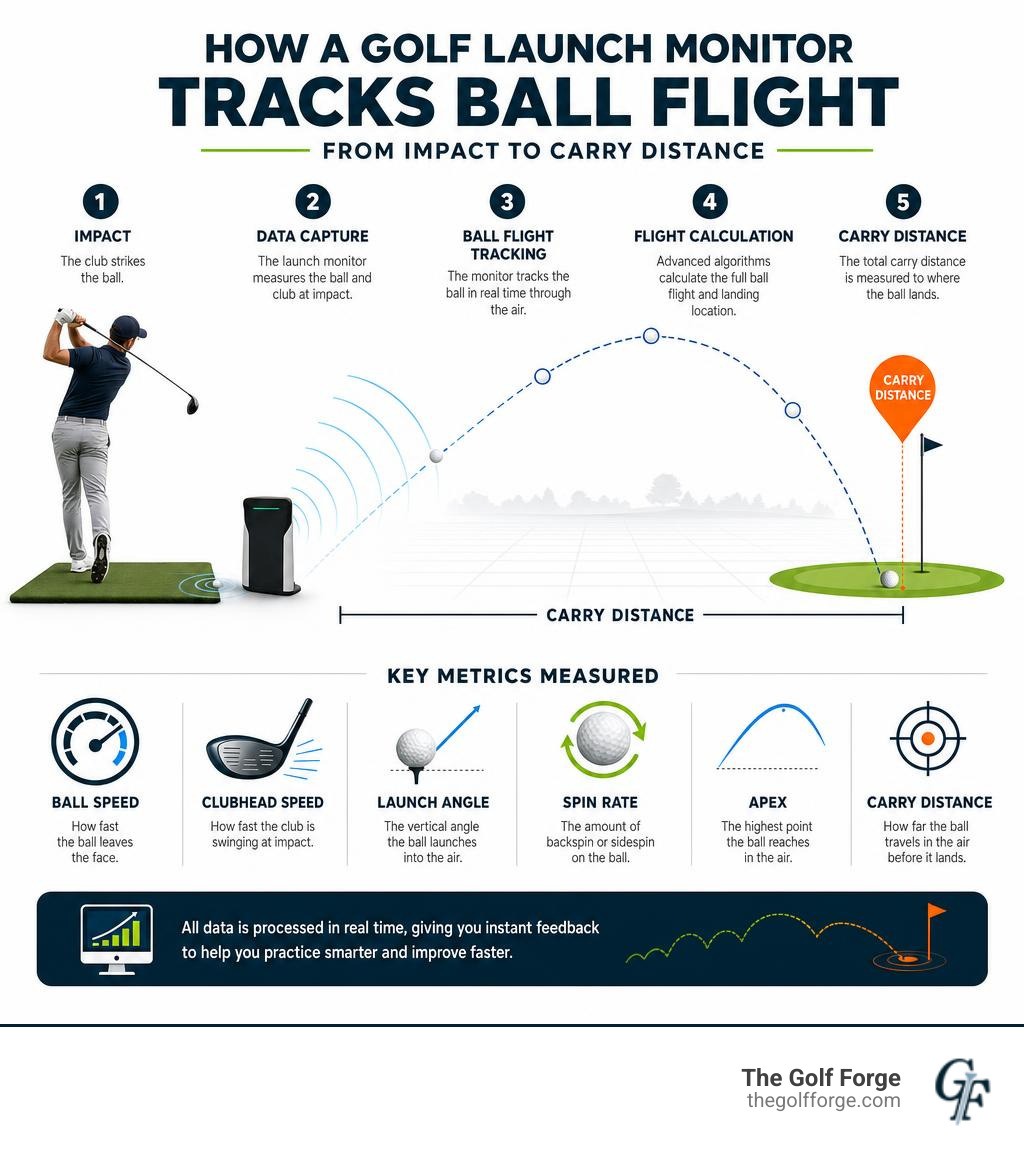
How Does a Golf Launch Monitor Work?
At its core, a golf launch monitor is a highly sophisticated data collector. However, how it collects that data depends entirely on the underlying technology. In the modern landscape of May 2026, systems generally fall into three categories: Doppler radar, photometric (camera-based), or a hybrid of both.
Doppler Radar Systems
Radar-based launch monitors sit behind the golfer (typically 6 to 10 feet) and emit microwave signals. When the club sweeps through and impacts the ball, the radar tracks the moving objects by measuring the shift in frequency of the reflected waves (the Doppler effect).
These systems are exceptional at tracking full ball flight outdoors because they can follow the ball for hundreds of yards. However, they can struggle in small indoor spaces where the ball only travels a few feet before hitting a net or screen. To combat this, advanced units like the FlightScope Mevo+ utilize "Fusion Tracking," which combines 3D Doppler radar with high-speed image processing to deliver reliable indoor and outdoor numbers.
Photometric (Camera-Based) Systems
Instead of tracking the ball's flight downrange, photometric systems sit to the side of the ball, pointing directly at the impact zone. They use ultra-high-speed cameras to capture thousands of images per second at the exact millisecond of impact.
By analyzing these high-resolution images, the system calculates the ball's starting direction, launch angle, and spin rate immediately after it leaves the clubface. Because they only need to see the first few inches of ball travel, camera-based systems are incredibly accurate in tight indoor spaces.
The gold standard of this technology is the GCQuad Launch Monitor | Tour-Trusted Golf Accuracy, which uses four high-speed cameras (quadrascopic imaging) to build a complete 3D model of the clubhead and ball at impact.
Infrared Sensor Systems
Often found in entry-level or older simulator setups, infrared systems measure club passage over a series of light sensors embedded in a hitting mat. While helpful for basic swing speed, they do not track actual ball spin or launch characteristics with the same precision as radar or cameras.
Key Metrics Tracked by Modern Systems
When you step up to a modern golf launch monitor, you are greeted by a screen filled with numbers. Knowing what these metrics mean is the key to transforming raw data into lower scores.

Ball Speed: The velocity of the golf ball immediately after impact. This is the single biggest factor in determining distance.
Clubhead Speed: How fast your club is moving right before impact. Increasing this speed is the primary goal of speed-training programs.
Smash Factor: Calculated as Ball Speed divided by Clubhead Speed. It measures energy transfer efficiency. A perfect strike with a driver yields a smash factor of around 1.50.
Launch Angle: The initial vertical angle of the ball's ascent relative to the ground.
Spin Rate: Measured in revolutions per minute (rpm). Spin keeps the ball in the air (lift) but can also cause ballooning or severe curvature if uncontrolled.
Carry Distance: The actual distance the ball travels through the air before hitting the ground.
Essential Ball Metrics Measured by a Golf Launch Monitor
To truly dial in your ball flight, you need to look beyond distance and speed. Premium monitors track advanced ball metrics that reveal the true physics of your shot:
Ball Velocity: The initial speed combined with the launch direction.
Launch Angle & Direction: Exactly how high and how far left or right the ball starts relative to your target line.
Spin-Tilt Axis: This represents the angle of the ball's rotation. If the spin axis tilts to the left, you get a draw or hook; if it tilts to the right, you get a fade or slice.
Total Distance: The sum of your carry distance and estimated roll-out, which varies based on landing angle and turf conditions.
Shot Curvature: Calculated from spin axis and speed, showing exactly how many yards your ball bends in the air.
Club Delivery Metrics for Swing Improvement
While ball metrics tell you what the ball did, club delivery metrics tell you why it did it. If you want to make lasting swing changes, working with a certified Swing Coach alongside these club metrics is the fastest path to success:
Club Path: The horizontal direction the club is traveling at impact (in-to-out or out-to-in).
Angle of Attack: The vertical angle at which the club strikes the ball. You want a downward strike (negative angle) with irons and an upward strike (positive angle) with a driver.
Face Angle: The direction the clubface is pointing (open, closed, or square) at impact.
Face-to-Path: The relationship between your clubface angle and swing path. This is the primary driver of shot curvature.
Impact Location: Premium camera systems show you exactly where the ball met the clubface (heel, toe, or dead center), which is crucial because off-center hits drastically reduce smash factor.
Choosing the Right System for Your Goals and Budget
Selecting a golf launch monitor in 2026 comes down to how and where you plan to use it, as well as your budget.
If you are looking for an ultra-portable budget tool to throw in your bag for outdoor range sessions, a Doppler-based unit under $500 like the Voice Caddie SC300i (~$340) or the Shot Scope LM1 (under $200) is highly effective. They give you reliable carry distances, swing speeds, and smash factors without requiring a complex setup.
However, if your goal is a dedicated indoor simulator bay where you can play virtual rounds of golf, you will want a camera-based system or a hybrid system with robust software integration.
Feature / Technology Radar-Based Systems (e.g., Mevo Gen 2, Mevo+) Camera-Based Systems (e.g., Bushnell Launch Pro, GCQuad) Primary Environment Best outdoors (ranges, open fields) Best indoors (studios, simulator bays) Space Required Needs 8 feet behind ball and 8+ feet of ball flight Minimal space; sits directly next to the ball Data Capture Tracks full ball flight downrange Captures exact impact and spin at launch Spin Accuracy Can be estimated indoors without metallic stickers Highly accurate measured spin (no stickers needed) Subscription Fees Usually none; optional one-time software upgrades Often requires annual subscriptions to unlock full data
Finding the Best Golf Launch Monitor for Home Simulators
If you are building a home simulator, the software ecosystem is just as important as the hardware. You want a launch monitor that integrates seamlessly with industry-leading simulator software like GSPro, E6 Connect, or FSX Play.
For a high-end, dedicated home simulator, the Garmin Approach R50 Golf Launch Monitor & Simulator represents a premium, versatile option. Priced at $4,999.99, it features a built-in 10-inch touchscreen to view impact videos directly, tracks over 15 ball and club metrics, and offers up to 4 hours of battery life for portable use.

When planning your space, ceiling height is the most critical constraint. You need at least 9 to 10 feet of clearance to comfortably swing a driver without fear of damaging your ceiling. Experiencing these systems in person at a professional indoor facility helps you decide whether you prefer a floor-mounted unit or an overhead camera system before making a major investment.
Frequently Asked Questions About Launch Monitors
Do budget launch monitors provide accurate data?
Yes, but with caveats. Budget units under $500 (like the Shot Scope LM1 or Voice Caddie SC300i) are incredibly accurate for tracking clubhead speed, ball speed, and carry distance when used outdoors. Because they use Doppler radar, they measure the actual movement of the club and ball. However, they do not measure spin rates or lateral deviation (hook/slice) with the same precision as a $4,000+ camera system. For consistent outdoor gapping and speed training, budget monitors are excellent tools.
What is the difference between radar and camera systems?
Radar systems track the ball's actual flight by measuring microwave reflections, making them superior for outdoor use where the ball can fly freely. Camera systems take high-speed photographs of the ball at the moment of impact, making them far superior for indoor spaces where ball flight is limited to a few feet. Radar systems require precise alignment behind the golfer, while camera systems sit adjacent to the hitting area and require minimal setup.
Do I need a subscription to use simulator software?
It depends on the brand. Brands like FlightScope (Mevo series) generally operate on an a la carte purchase model with no annual subscription fees for basic software. Conversely, premium camera-based systems like the Bushnell Launch Pro require annual subscription plans (such as their Gold software package) to unlock full simulation capabilities, advanced club data, and third-party software integration. Always factor in these potential recurring costs when calculating your total budget.
Conclusion
Whether you are looking to buy a portable unit for the driving range or design a complete virtual golf setup at home, a golf launch monitor is the ultimate game-changer. By replacing guesswork with precise ball and club metrics, you can practice with a clear purpose and track your improvement over time.
For those in Utah who want access to world-class tracking technology without the massive upfront cost of buying a premium system, we have you covered. At The Golf Forge, we operate state-of-the-art indoor golf simulators in South Jordan, UT, and West Jordan, UT.
Our facility features advanced Foresight launch-monitor technology in private, 24/7-accessible bays, giving you the perfect environment for consistent, data-driven practice. If you are ready to take your game to the next level, explore our Services or check out a Tour Demo to see our technology in action.
Ready to hit the virtual links? Book Now and start practicing like the pros to see how indoor golf is taking over the Wasatch Front!