
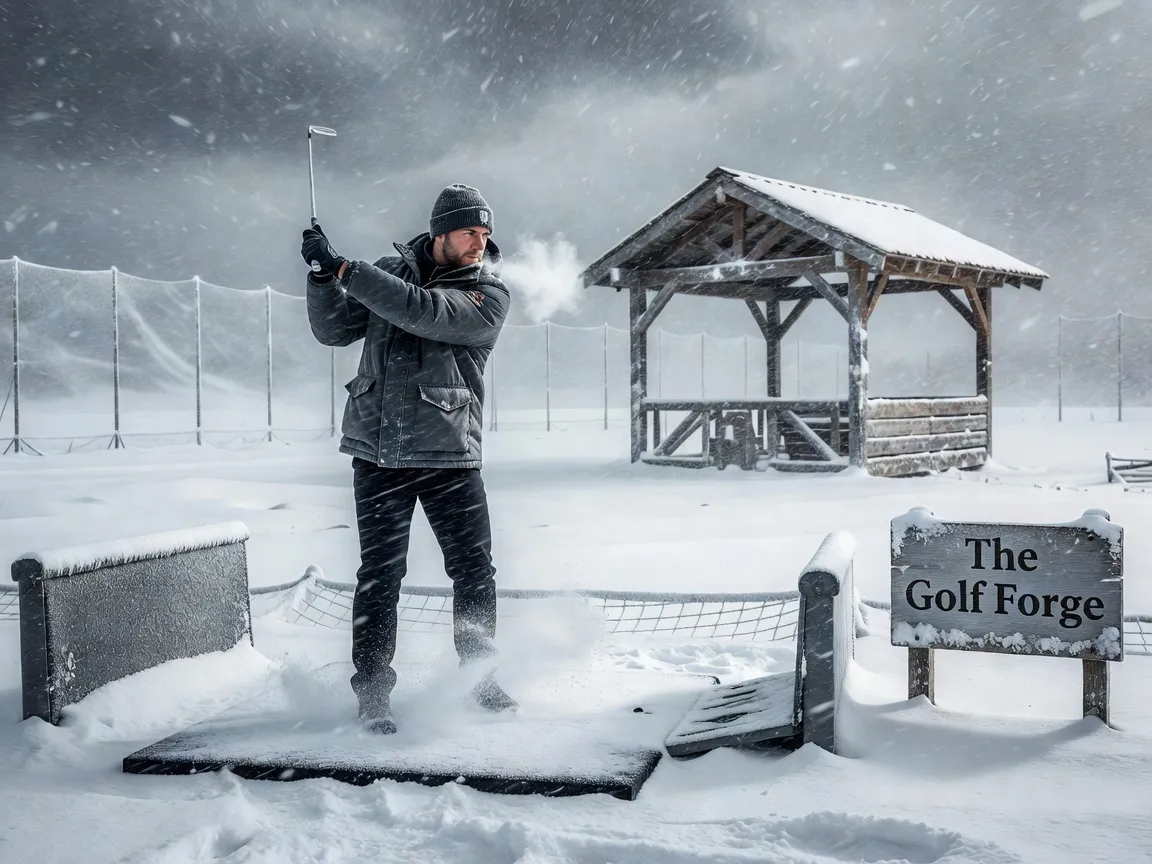
How to Keep Your Golf Game Sharp When the Weather Outside is Frightful
There is nothing more frustrating than watching months of hard-earned swing progress completely vanish the moment winter weather forces you off the course. You spend all summer grinding to lower your handicap, only to feel like a beginner again when spring finally rolls around. If you are tired of starting from scratch every single year, the winter off-season does not have to be a lost cause.
That is where The Golf Forge changes the game. With state-of-the-art Foresight Falcon launch monitor technology, expert swing coaches, and private 24/7 bays in South Jordan and West Jordan, UT, you can turn cold months into your biggest competitive advantage. Without the immediate pressure of a weekend scorecard, the off-season gives you the ideal environment to execute deep, lasting technical mechanical fixes and build permanent muscle memory.
Industry statistics show that indoor golf practice surges by 300% during the winter months among dedicated players. Furthermore, USGA and NGF data indicate amateur golfers have improved by 12% over the past 25 years — a leap driven largely by access to structured year-round practice opportunities and technology.
When you practice in a controlled indoor environment, you can isolate key mechanics:
Swing plane consistency: Correcting over-the-top moves without worrying about where a shanked shot lands outdoors.
Posture alignment and grip: Setting your setup fundamentals so they feel completely automatic come spring.
Clubface control at impact: Working on flexed lead wrist mechanics to ensure clean, compression-first ball striking.
By establishing a committed routine for Indoor Golf Practice, you eliminate the dreaded three-month regression that plagues most players every winter.
How to Practice Golf in the Winter Using High-Impact Indoor Drills

You do not need an entire indoor driving range in your basement to maintain touch and precision. In fact, focused drills performed in modest spaces often build better mechanics than mindlessly hitting full-power drivers into a windy sky. By stripping away visual distractions, you can hone impact precision, body rotation, and strike consistency right in your living room or garage.
Essential Putting Drills for How to Practice Golf in the Winter
According to PGA Tour statistics, putting accounts for roughly 40% of all golf shots during a round. Yet weekend golfers spend upwards of 80% of their practice time bashing drivers. While PGA Tour professionals average 1.737 putts per round, high-handicap amateurs average far more — presenting the single quickest area to shave strokes off your game before spring.
To master how to practice golf in the winter on carpet or a basic putting mat, focus heavily on start-line accuracy and backstroke tempo rather than hole makes.
The Coin Start-Line Drill
Place a small coin (like a dime) on your carpet exactly 12 to 18 inches in front of your golf ball setup. Your goal is to roll every putt directly over the coin.
Why it works: The first three feet of any putt determine whether the ball stays on your intended line. If you can consistently hit a mark 12 inches away, your start-line alignment is locked in.
The Putter Gate Drill
Set two books or alignment sticks on either side of your putter head, leaving just a quarter-inch clearance on the heel and toe.
Why it works: Striking putts out of the heel or toe twists the putter face at impact. Hitting reps through a narrow gate forces a square center strike.
Backstroke Length & Metronome Tempo
Distance control in putting is governed almost entirely by backstroke length rather than forcing a heavy follow-through. Great putters maintain a smooth backswing-to-downswing tempo ratio of approximately 2:1.
Download a free metronome app on your phone and set it to 80 beats per minute (BPM).
Count "one" for the backswing and "two" for impact. Practice varying your backswing length to control speed rather than pushing the club through forcefully.
Chipping and Short Game Drills for Limited Indoor Space
Dave Pelz’s research shows that between 60% and 65% of all golf shots occur within 100 yards of the hole. Maintaining landing spot precision around the greens preserves your touch when outdoor turf is frozen solid. You can review additional Winter Golf Practice Tips - The Golf Hub to see how tour players maintain short game feel indoors.
The Towel Lie Simulation Drill: Lay a hand towel flat on your rug or garage mat, placing the golf ball in the center. Practice low-flight chip shots with an 8-iron or pitching wedge, focusing on sweeping the ball cleanly off the towel without catching the fabric first. This trains ball-first strike precision.
Rubber Band Center-Contact Test: Wrap two thin rubber bands around the face of your wedge, leaving a sweet-spot opening wide enough for a golf ball. Chip foam or practice balls into a pop-up net or laundry basket. Off-center hits will strike the rubber bands, dampening the feel and providing immediate feedback.
Quiet-Hands Weight-Forward Setup: Set your feet close together with roughly 60% of your body weight leaning onto your lead foot. Keep your hands calm through impact to prevent the urge to scoop or lift the ball into the air.
Maintaining Full Swing Mechanics Indoors Without a Simulator
If low basement ceilings prevent full-speed driver swings at home, focus on mirror checks and slow-motion sequencing. For more low-space ideas, explore these Stop Winter Rust: 9 Indoor Practice Secrets Weekend Warriors Use.
Mirror Posture and Alignment Audits
Position a floor-length mirror face-on and down-the-line relative to your setup.
Check your spine angle, shoulder turn, and lead wrist position at the top of your backswing.
Ensure your lead wrist remains flat or slightly flexed (bowed) at the top, avoiding cupping (extension) which causes open clubfaces and weak slices.
The Wall Drill for Sway Control
Stand with your trail hip set roughly one inch away from a wall. Take slow-motion backswings.
If your hip bumps heavily into the wall during your takeaway, you are swaying off the ball rather than rotating inside your posture.
Focus on turn and hip depth rather than lateral slide.
The Pump Drill for Swing Sequencing
Take your club back to the top of your backswing. Pause, then slowly lower your hands down to belt height while allowing your hips to initiate their forward rotation. Return to the top, repeat twice, and then follow through in slow motion. This trains proper downswing sequencing — hips clearing first, followed by torso, arms, and clubhead.
How to Structure Your Weekly Routine and Utilize Technology
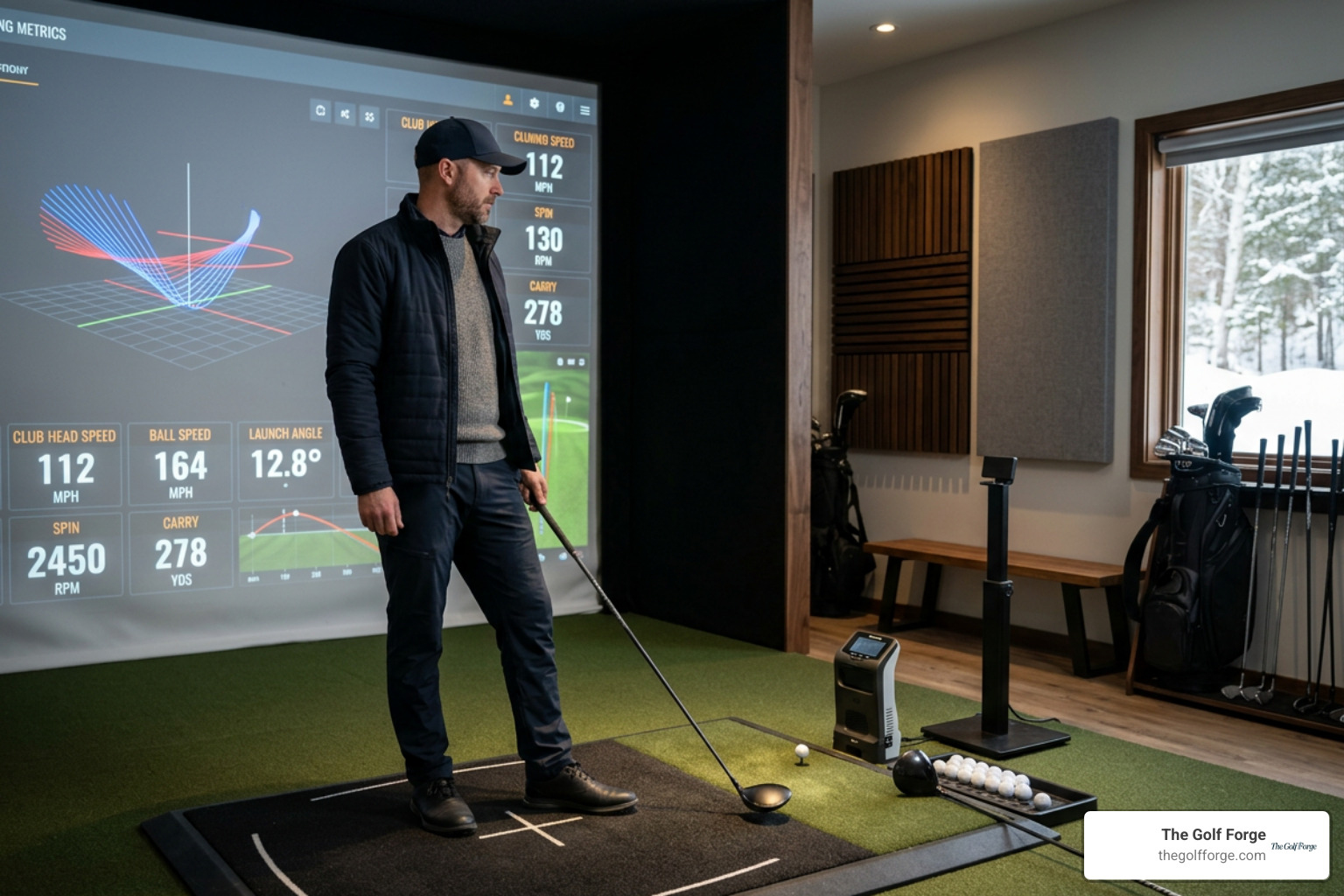
Unstructured practice leads to ingrained bad habits. Swinging wildly into a garage net without feedback can degrade your mechanics faster than taking the winter off completely. To maximize off-season gains, balance home fundamental drills with high-tech data tracking inside dedicated indoor environments.
Structuring a Weekly Routine for How to Practice Golf in the Winter
Rather than hitting balls for hours once a week, aim for frequent, bite-sized practice blocks of 30 to 45 minutes. You can adapt a structured Winter Golf Practice Routine: Stay Sharp When You Can't Play - Local Golf Sims to keep your schedule predictable and effective.
Here is a balanced weekly winter template:
Day | Practice Focus | Environment & Duration | Key Objectives |
|---|---|---|---|
Monday | Putting & Start Line | Home Mat (20 mins) | 50 reps over coin drill; tempo metronome work |
Tuesday | Short Game & Contact | Home / Net (30 mins) | Towel lie chips; rubber band wedge strike checks |
Wednesday | Physical Mobility & Core | Living Room (20 mins) | Hip 90/90s, thoracic spine rotations, planks |
Thursday | Full Swing Data & Speed | Indoor Bay (45 mins) | Launch monitor metrics, clubface control, path audit |
Friday | Rest Day | N/A | Recovery and mental strategy review |
Saturday | Simulated Play & Target Pressure | Indoor Bay (60 mins) | 9-hole simulated round; target dispersion challenges |
Sunday | Mirror Checks & Setup Audit | Home Mirror (15 mins) | Grip verification, spine angle, posture alignment |
Leveraging Launch Monitors and Technology for Accurate Data Feedback
While small-space drills at home keep your hands sharp, nothing replaces real ball-flight data. High-resolution launch monitors bridge the gap between indoor feel and outdoor execution.
When training in our private 24/7 bays at The Golf Forge in South Jordan and West Jordan, UT, our Foresight Falcon launch monitor technology measures critical data parameters on every swing:
Clubhead Speed & Ball Speed: Track your smash factor (ball speed divided by clubhead speed) to ensure distance gains come from solid contact rather than aggressive swinging.
Face-to-Path Angle: Understand why your ball curves. A clubface open relative to your swing path produces slices; a closed face creates hooks.
Launch Angle & Spin Rate: Fine-tune your launch windows to maximize carry distance.
Carry vs. Roll Calibration: Colder winter weather misleads outdoor distance perception. Launch monitors deliver exact carry numbers so your yardage gaps remain precise.
Combining precision technology with a high-end Golf Simulator Experience removes guesswork, letting you measure progress objectively week after week.
Common Winter Golf Practice Mistakes and How to Avoid Them
Even dedicated golfers fall into predictable traps during winter practice. Recognizing these mistakes keeps your offseason productive and injury-free. Check out these insights from Winter Golf Practice: Stay Sharp When It's Cold | Hole19 for additional guidelines on cold-weather practice safety.
Chasing Maximum Swing Speed Without Swing Control: Bashing drivers into a screen solely to achieve personal-best ball speed leads to wide dispersion patterns. Always prioritize centered strike contact and clubface control before chasing speed.
Practicing Without Visual Feedback: Hitting hundreds of balls into a blank net without a mirror, camera, or launch monitor ingrains flaws. If your clubface is open at impact into a net, you are spending hours grooving a slice.
Swinging Hard with Cold Muscles: Cold weather and indoor garage temperatures stiffen soft tissues. Cold muscles are highly susceptible to strain. Perform 5 to 10 minutes of dynamic warm-ups (arm circles, torso twists, leg swings) before making full swings.
Single-Skill Overemphasis: Spending three months exclusively hitting drivers means your touch inside 50 yards will be nonexistent come spring. Maintain a balanced routine that splits time between putting, chipping, full swing, and mobility.
Ignoring Expert Guidance: Trying to self-diagnose complex swing flaws through social media videos often compounds the problem. Working directly with a dedicated Swing Coach during the off-season ensures you practice the right movements from day one.
Transitioning Your Winter Game Back to the Outdoor Course in Spring
Transitioning from flat indoor mats back to real grass fairways requires a short adaptation phase. Reviewing guidebooks like How to Improve Your Golf Game During the Winter - Legends Golf Course & Villas highlights why patience is key during your first weeks outdoors.
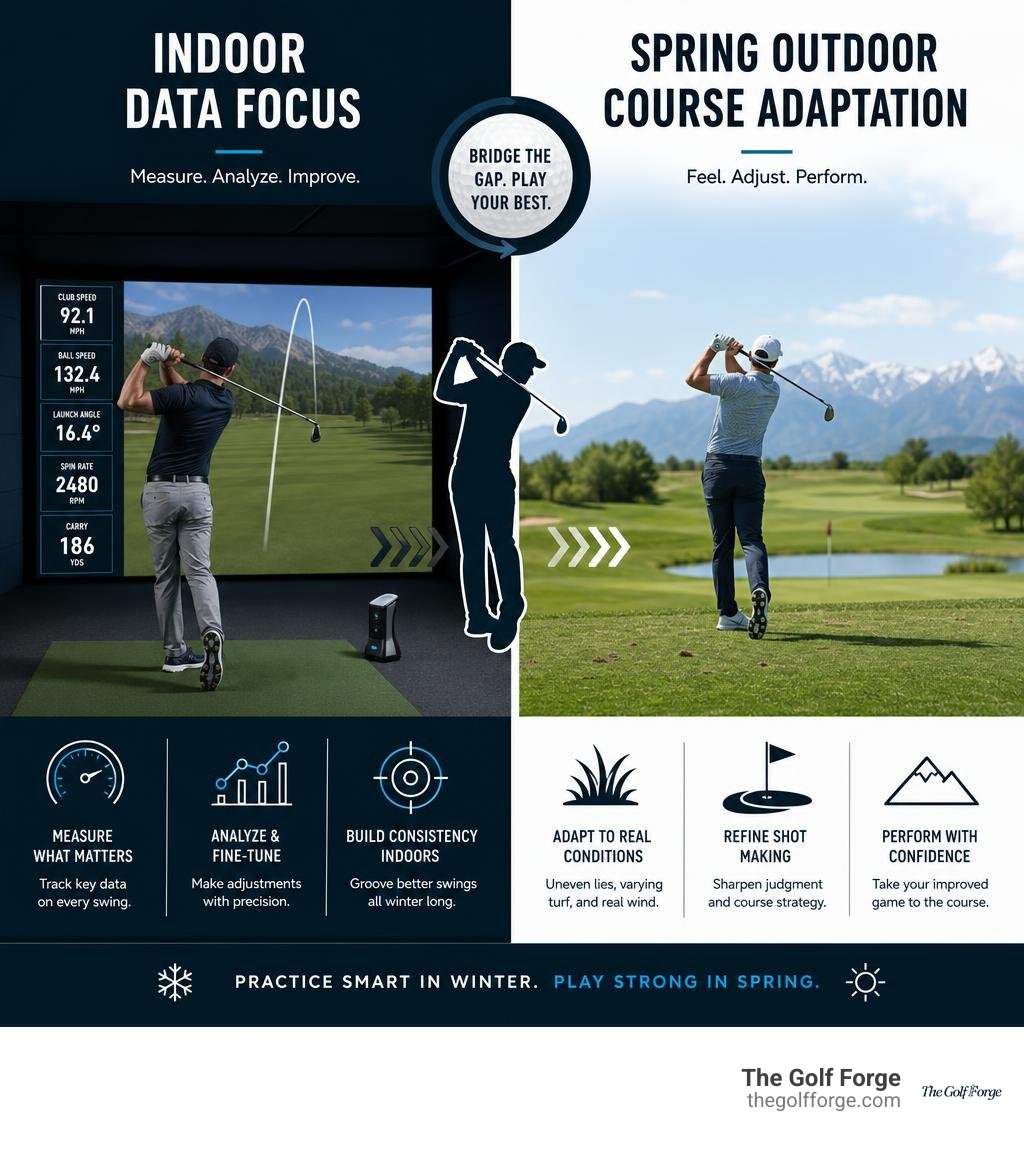
Use this two-week transition protocol when spring weather opens outdoor courses:
Factor | Indoor Simulator Environment | Outdoor Course Realities | Spring Adjustment Protocol |
|---|---|---|---|
Turf & Lies | Perfect, level synthetic mats | Uneven lies, divots, rough, soft turf | Practice low-finish punch shots to guarantee ball-first contact |
Green Speeds | Consistent stimp readings | Varying green speeds, slope, grain | Spend 20 minutes on the outdoor practice green calibrating lag putts |
Air Density & Distance | Controlled indoor temperature | Cold spring air (loses 2–3 yds / 10°F drop) | Club up one full club on approach shots during early spring rounds |
Visual Target Lines | Screen references & visual grids | Open landscapes, trees, wind, hazards | Pick precise target lines (e.g., specific tree branches) during pre-shot setup |
Frequently Asked Questions About Winter Golf Practice
How often should I practice golf during the winter months?
Aim for 3 to 4 bite-sized sessions per week lasting 30 to 45 minutes each. Short, consistent practice sessions build long-term muscle memory far more effectively than single long, sporadic practices.
How can I practice my full swing indoors safely with limited space?
Focus on slow-motion mechanics in front of a mirror, wall alignment drills, and impact bag training. If ceiling heights prevent full swings at home, reserve your high-speed full swings for high-ceiling indoor facility bays equipped with proper safety enclosures.
What is the most effective golf skill to practice indoors during winter?
Putting — specifically start-line accuracy and tempo control. Because putting represents roughly 40% of all golf strokes and relies entirely on mechanics rather than ball flight distance, indoor carpet work transfers directly to real courses.
Conclusion
Winter does not have to break your game's momentum. By combining low-space home drills for putting and setup precision with high-tech data tracking, you transform the off-season into your secret scoring advantage.
When you are ready to take your winter practice to the next level, step out of the cold and into our 24/7 private simulator bays at The Golf Forge in South Jordan and West Jordan, UT. Work with expert swing coaches and utilize state-of-the-art Foresight Falcon launch monitor technology to build a consistent, powerful swing that dominates come spring.
Ready to transform your game this offseason? Explore Our Off-Season Services and book your private bay today!