

Practice Golf Balls That Deliver Real Flight Dynamics in Small Spaces
Limited Flight Practice Balls Make Small-Space Golf Training Possible
Bad weather, a busy calendar, and a small backyard can turn a good practice plan into another missed range session. Golf practice balls limited flight are a useful alternative when you want to make real swings without sending a regulation ball 200 yards or more.
The best options reduce distance while still giving you visible launch, curve, and strike feedback. Some models stop around 40 yards, while dense foam designs may travel roughly one-third of normal distance or as far as 100 to 110 yards. Choose the ball based on your available clearance, nearby windows and people, and whether you are practicing outdoors, chipping indoors, or hitting into a net.
For practice that goes beyond visual feedback, The Golf Forge offers private 24/7 indoor bays in South Jordan and West Jordan, with Foresight Falcon launch-monitor data and access to swing coaches. You can practice year-round and see the numbers behind your contact, launch, and ball flight.
This roundup compares the limited-flight ball styles that provide the most useful feedback in confined spaces, along with the safety limits that matter before you take a full swing.

The Mechanics of Restricted Distance Golf Training

When practicing away from a traditional driving range, safety and accurate feedback must go hand in hand. Standard regulation golf balls weigh around 45.9 grams and carry immense kinetic energy. Launching one in a standard residential area creates serious property risks. Perforated plastic wiffle balls solve the safety problem, but they flutter unpredictably, offer almost zero clubface resistance, and mask your real swing path.
Modern restricted-flight training aids bridge this gap. By utilizing specialized foam golf balls and advanced aerodynamic structures, these balls absorb impact energy while maintaining true-to-life trajectory simulation.
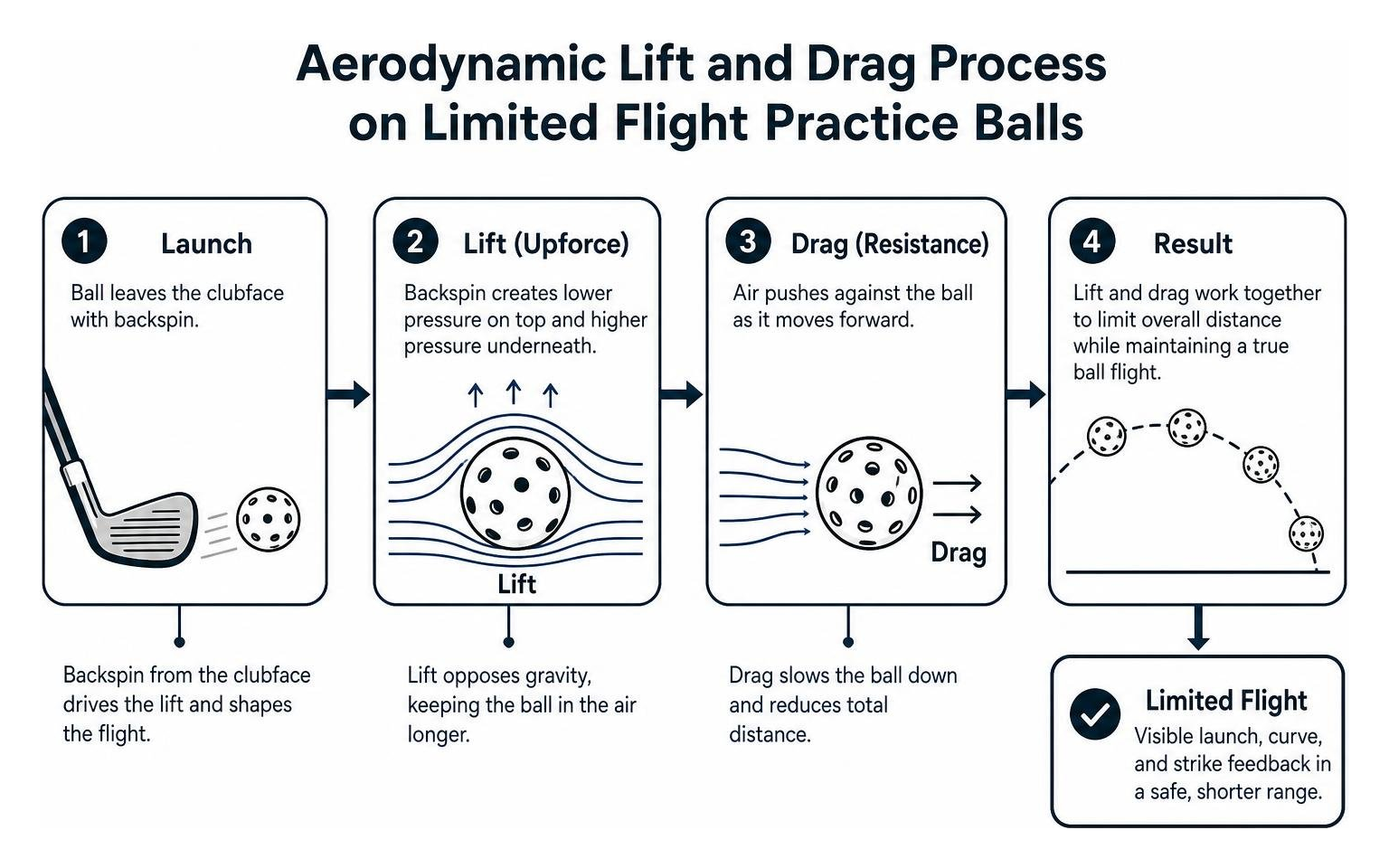
Why Golf Practice Balls Limited Flight Differ from Regulation Spheres
Standard golf balls use solid or multi-layer rubber cores covered in durable surlyn or urethane, designed to maximize the coefficient of restitution (COR) and transfer maximum clubhead velocity into pure distance.
In contrast, engineered limited-flight alternatives manipulate mass, compression, and aerodynamics:
Mass and Core Density: While regulation spheres weigh nearly 46 grams, training models like the ALMOSTGOLF Point3 Limited Flight Practice Golf Balls – Realistic Spin, Trajectory, & Accuracy Foam Training Balls Pack of 24 weigh just 13.5 grams—roughly one-fourth the weight of a standard ball. Other compressed composite models weigh around 14 grams, while cylindrical polymer designs check in at about half the weight of a normal ball.
Controlled Energy Transfer: High-performance training balls feature a low .32 COR rating, limiting rebound velocity off the clubface while preserving genuine impact feel.
Horizontal Reverse Spin Axis: When struck purely, these balls compress against the face and generate genuine backspin around a horizontal axis.
Aerodynamic Braking: Rather than cutting smoothly through the air indefinitely, limited-flight balls generate high drag. Cylindrical designs oscillate between flat and open-air profiles every quarter revolution, generating simultaneous lift and aerodynamic braking that caps total flight.
Safety Protocols and Space Requirements for Backyard Practice
Before setting up an outdoor hitting zone, measure your yardage to prevent wayward shots from causing issues with neighbors:
Corridor Clearance: High-density foam models can travel up to 100 or 110 yards on pure driver strikes. If your yard only offers a 20- to 40-yard corridor, use cylindrical designs or hit dense foam balls strictly with short irons and wedges.
Surface Abrasion: Hitting off rough concrete or hard gravel causes micro-fissures in polymer practice balls. Pair your setup with dedicated hitting mats like the BirdieBalls & Blemished StrikePad Set - Practice Anywhere! or the BirdieBall Turf Set | 1 Dozen Full-Swing Limited Flight Practice Golf to protect your clubs and practice balls.
Temperature Thresholds: Rigid polymer practice aids become brittle in cold weather. Never strike polymer balls in temperatures below 45°F (7.2°C), as impact stress will crack the material.
Top Golf Practice Balls Limited Flight for Real Flight and Spin

Product / Category | Max Flight Distance | Weight | Core / Material | Best Practice Setting | Temperature Limit |
|---|---|---|---|---|---|
Cylindrical Aerodynamic Trainers | ~40 Yards | ~23g (50% of real ball) | High-Grade Copolymer Cylinder | Small yards, parks, school fields | 45°F minimum |
Cross-Linked Foam Pressure Balls | 1/3 Distance (~100 yds max) | 13.5g (25% of real ball) | Internal CO2 Pressure Core (.32 COR) | Medium yards, light indoor chipping | All weather conditions |
High-Density Composite Foam Balls | ~110 Yards | 14g | Compressed High-Density Foam Shell | Backyards, garage nets, wedge zones | All weather conditions |
Cylindrical Aerodynamic Trainers
Cylindrical options like the Single BirdieBall - The Revolutionary Practice Golf Ball and the Practice Golf Balls for At-Home Training - Pack of 12 re-engineer the ball's physical geometry. Rather than a dimpled sphere, these trainers use an open-ended polymer cylinder.
When struck with a full swing, the cylinder compresses against the clubface, springing back to generate high-speed reverse spin. The quarter-revolution oscillation between the open cavity and the flat wall creates a turbine effect with an audible whirring sound.
With an overall customer rating of 4.89 / 5 across 274 reviews, these trainers strictly restrict travel to roughly 40 yards, allowing golfers to take full driver swings in tight spaces without losing true draw or fade feedback. They can also be paired with velocity tees for driver drills.
Cross-Linked Foam Pressure Balls
For golfers who prefer a traditional spherical profile, models like the 24 Ball Pack and almostGOLF Limited Flight Golf Balls – Par2Pro utilize cross-linked foaming and internal CO2 pressure technology.
Weighing 13.5 grams with a .32 COR rating, these balls travel approximately one-third the distance of a regulation golf ball, maxing out at roughly 100 yards with a driver. Their textured dimple patterns and internal pressure cores match authentic launch angles and spin axes.
If you come over the top, you will see an authentic slice trajectory; if you deliver an inside-out path with a closed face, you will see a reliable draw. As a bonus, they float in water and use non-toxic materials.
Compressed High-Density Composite Balls
Options such as the F4 Pure Contact Limited Flight Practice Golf Balls – 12 Pack and 14-gram high-density foam flight trainers provide a firmer impact response for mid-iron and short-game work.
Capping flight at roughly 110 yards, these models feature a durable compressed foam shell that resists scuffing and tearing. They provide excellent feedback for backyard wedge pitching, chipping drills, and garage net routines without risking interior property damage.
Maximizing Small-Space Drills and When to Upgrade to Studio Simulators
To get the most out of backyard and living room sessions, establish structured drills:
Alignment and Strike Station: Place alignment sticks down to establish your target line. Use a dedicated strike mat with swing-path guides to ensure you are catching the ball cleanly rather than flipping your wrists.
Trajectory Shaping Checks: Hit five consecutive balls aiming for a neutral start, followed by three intended push-draws and three pull-fades. Watch the curvature over the first 20 to 30 yards to confirm clubface control.
Wedge Clock Drills: Practice half, three-quarter, and full wedge swings to dial in tempo and consistent contact.
While limited-flight balls are great for keeping your hands active, they have natural training limitations. Entry-level consumer radar launch monitors often struggle to read lightweight foam balls, resulting in missed shots or inaccurate data. Furthermore, visual ball flight in a 30-yard yard cannot reveal precise clubhead speed, attack angle, dynamic loft, or exact carry yardages.
When you want to validate your mechanical progress with tour-level accuracy, integrating indoor golf practice into your regular training routine ensures you aren't guessing about your numbers.
Selecting Golf Practice Balls Limited Flight for Tight Yards
High-Visibility Finishes: Choose high-visibility yellow or neon finishes for outdoor grass sessions so you can easily spot and retrieve balls.
Simulator Screen Cautions: If hitting into projection screens or white impact enclosures, use white practice balls, as dyed yellow balls can leave color scuffs during high-velocity impacts.
Wear Inspection: Inspect balls periodically for micro-tears or plastic fatigue, discarding damaged balls to maintain consistent flight patterns.
Elevating Ball-Striking with Data-Driven Indoor Bays
At The Golf Forge, we take training beyond visual estimates. Our dedicated facilities in South Jordan and West Jordan feature private, climate-controlled hitting bays equipped with ceiling-mounted Foresight Falcon launch monitors.
Unlike home setups with limited distance and tracking constraints, our overhead photometric monitors track every critical variable at club impact and initial ball launch using regulation balls:
True Club Data: Measure club path, face-to-path angle, impact location on the face, and angle of attack with pinpoint precision.
Full Ball Flight Physics: Review true ball speed, launch angle, horizontal azimuth, backspin, and side spin.
Professional Coaching: Work directly with our certified swing coaches to translate data insights into actionable swing adjustments.
Whether you are practicing late at night after work or seeking structured swing refinement, our private bays provide the focused environment necessary for rapid improvement.
Frequently Asked Questions About Limited Flight Golf Balls
How far do limited flight practice balls travel compared to real golf balls?
Most limited-flight balls travel between one-third and one-half the distance of a standard golf ball. Cylindrical trainers max out at roughly 40 yards regardless of clubhead speed, while pressurized foam balls travel up to 100 to 110 yards on full driver swings.
Can you shape draws and fades with reduced distance practice balls?
Yes. Because premium limited-flight balls compress and rotate on an authentic horizontal spin axis, they exhibit real aerodynamic curvature. An open clubface relative to your swing path will produce a visible fade or slice, while a closed face will produce a clear draw.
Why do plastic polymer practice balls crack in cold weather?
Polymer plastics become rigid and brittle when exposed to ambient temperatures below 45°F (7.2°C). Striking a cold polymer ball at full swing speed creates extreme localized stress that shatters or cracks the plastic. Always store your training balls indoors at room temperature and avoid freezing outdoor sessions.
Conclusion: Level Up Your Ball Striking Year-Round
Limited-flight practice balls are an exceptional tool for backyard drills, warm-ups, and casual swings when time is tight. However, shaving strokes off your handicap requires precise feedback, consistent training conditions, and data-driven swing analysis.
At The Golf Forge, our private 24/7 bays in South Jordan and West Jordan give you full access to industry-leading Foresight Falcon technology in an uninterrupted, weather-proof setting. Whether you want to fine-tune your launch angles, eliminate an unwanted curve, or work directly with an experienced swing coach, we provide the ultimate golf simulator experience.
Explore our flexible membership options—including Bronze, Silver, Gold, and Corporate tiers. Our Corporate memberships offer an exceptional platform for team-building events, entertaining clients, and providing wellness perks with round-the-clock bay access for busy professionals.
Ready to transform your swing? Check out our guide to indoor golf practice balls, book your private golf practice bay South Jordan UT session today, and experience what real data can do for your game.