
Top-Rated Indoor Golf Practice Balls to Keep Your Game Sharp
Why the Right Indoor Golf Practice Balls Can Make or Break Your Game
You've been there — standing in a cold garage, swinging at a foam ball into a net, with zero idea if that shot was a draw or a dead pull. The ball lands two feet away, tells you nothing, and your game stays stuck.
That feeling is frustrating. And it's more common than you think.
Indoor golf practice balls are a popular solution for golfers who want to keep swinging when the weather turns or the range isn't an option. But not all practice balls are created equal — and the type you choose has a big impact on how much you actually improve.
Here's a quick look at the most popular types:
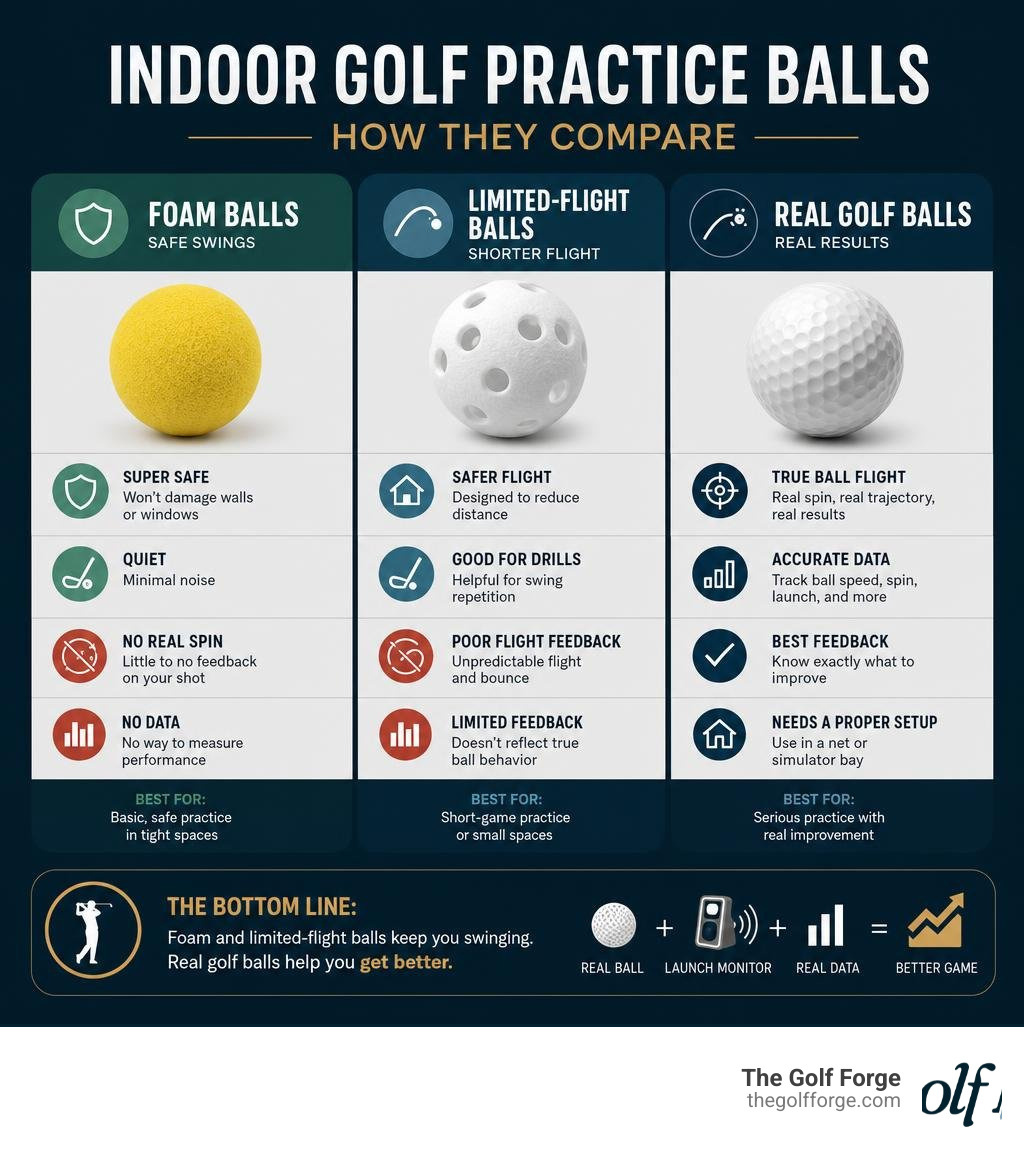
Ball Type Best For Key Limitation Foam (polyurethane) Safe indoor swings No real spin or ball data Plastic wiffle-style Backyard short game Poor flight feedback Limited-flight balls Small-space driving Still lacks true ball physics Real golf balls Simulator training Needs a proper hitting bay
The honest truth? Most at-home practice balls are a compromise. They keep you swinging, but they can't tell you your launch angle, spin rate, or carry distance. For golfers serious about improvement, that missing data is a big problem.
That's where a professional indoor simulator facility changes everything. Instead of guessing, you hit real golf balls and get real numbers — instantly.
The Golf Forge offers exactly that. With 24/7 private simulator bays in South Jordan and West Jordan, UT, powered by Foresight Falcon launch monitor technology, every swing gives you accurate ball speed, spin, launch angle, and more. No foam balls. No guesswork. Just the data you need to actually get better.
The Limitations of At-Home Indoor Golf Practice Balls

For many golfers in Utah, setting up a temporary practice space in the basement, garage, or spare room seems like the perfect way to survive the winter months or squeeze in a late-night session. To protect the drywall, the family dog, and nearby windows, we naturally reach for indoor golf practice balls made of foam or plastic.
At first glance, they check all the boxes:
They are incredibly safe and won't shatter a window if you catch one thin.
They reduce the deafening crack of a driver impact to a quiet, neighbor-friendly thud.
Their limited flight distance means you only need a few yards of clearance to make a full swing.
However, these benefits come at a steep cost to your actual game. The major drawback of practicing with foam or lightweight plastic balls is the complete lack of realistic feel, spin, and distance feedback. Because these balls weigh a fraction of a standard 45.9-gram golf ball, they do not compress against the clubface. Without compression, you lose the sensory feedback that tells your hands and brain whether you struck the ball flush or off the toe.
Even worse, hitting low-quality practice balls can actively ruin your swing muscle memory. A foam ball cannot replicate the aerodynamics of a real ball. It might fly straight in your living room, but that same swing on a real course could result in a massive slice or a hook. Without an accurate ball flight path, you risk reinforcing bad habits, thinking your swing is perfect when it is actually drifting out to in.
While some golfers look for local outdoor driving ranges during the warmer months, practicing indoors during the off-season shouldn't mean compromising your swing. A professional simulator environment is vastly superior to a DIY home setup because it allows you to train with real, premium golf balls in a completely safe, climate-controlled space.
Types of Indoor Golf Practice Balls and How They Perform
When shopping for indoor golf practice balls, you will quickly realize there is a massive variety of materials, designs, and price points on the market. Let’s break down how they compare across durability, material composition, and performance.
Foam and Plastic Practice Balls
Foam and plastic balls are the most common entry-level options. Brands like GoSports, Callaway, JAYA, and Guirnd dominate this space on retail platforms like Amazon, where consumer demand remains incredibly high. For instance, GoSports Foam Practice Balls have accumulated over 10,000 customer reviews, while Guirnd and Bac-kitchen packs regularly see thousands of monthly purchases.
These balls are typically made from polyurethane (PU) foam or lightweight hollow plastic. For example, the FORB PU Foam Golf Balls weigh a mere 7.5 grams each but feature a molded 336-dimple design to mimic the look of a real ball. Other brands, like GoSports, offer slightly denser foam options weighing between 9.5 and 10.5 grams to provide a touch more resistance.
While these lightweight designs are excellent for protecting your home's interior, they fail fundamentally at mimicking real ball flight, spin, or launch angles. They are highly susceptible to air resistance, meaning any attempt to analyze your shot shape or distance is purely speculative.
Limited-Flight and Restricted-Distance Balls
If you are looking for something a step above basic foam, specialized limited-flight balls offer a unique alternative. These designs attempt to bridge the gap between safety and realistic flight physics.
A prime example is the patented Single BirdieBall - The Revolutionary Practice Golf Ball , which is also sold in convenient packs like the Practice Golf Balls for At-Home Training - Pack of 12 | BirdieBall . Rather than a sphere, the BirdieBall is a hollow cylinder. When struck, it compresses and springs back, creating a patented "turbine effect" that generates reverse spin around its horizontal axis. It flies up to 40 yards with a full swing, drawing and fading just like a real ball while producing a satisfying, loud whirring sound.
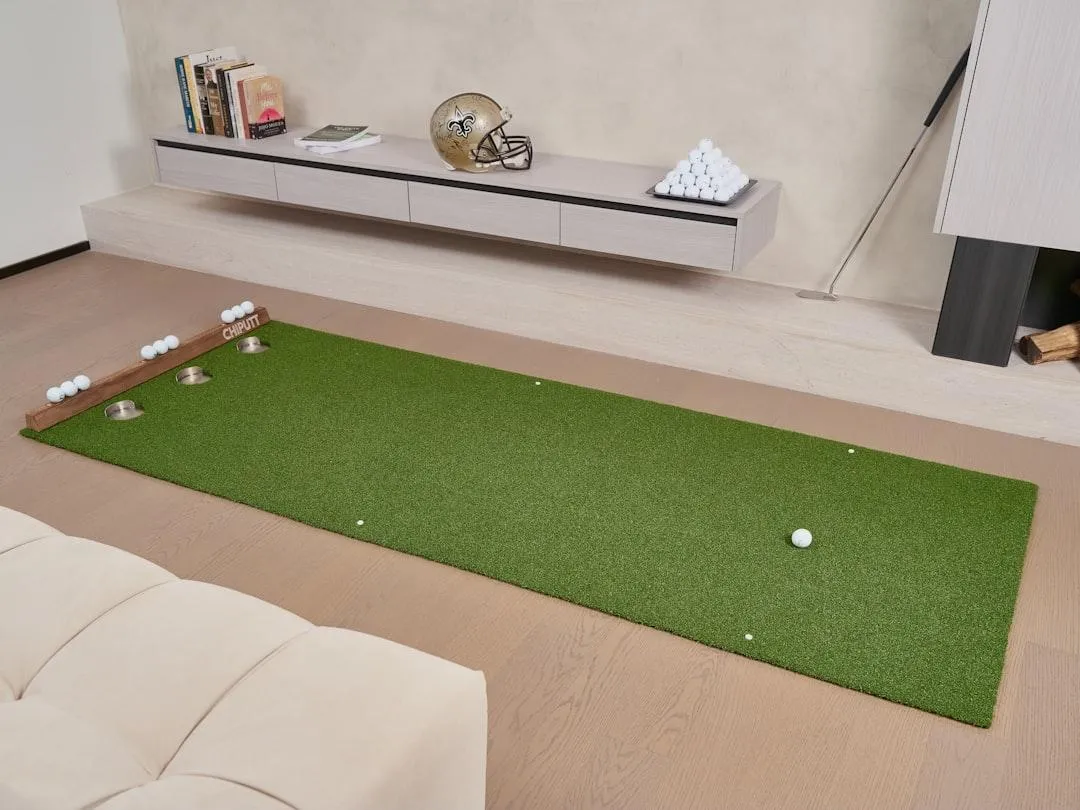
You can even pair them with a specialized hitting surface using the BirdieBalls & Blemished StrikePad Set - Practice Anywhere! to protect your clubs on hard surfaces. For putting practice, some golfers even use specialized mats like the 3' X 14' Deluxe Indoor Putting Green Package - BirdieBall to dial in their short game.
Other limited-flight options include almostGOLF balls, which utilize a proprietary CO2 pressure technology to travel about one-third the distance of a regulation ball, and the XPRT Fitness Practice Golf Balls 12pk Limited Flight Indoor Outdoor Tr , which feature a hollow construction with 26 symmetrical holes to control distance.
While these products are innovative, they still fall short of real golf ball physics. They cannot be used effectively to measure precise launch monitor metrics because their weight, shape, and aerodynamics are fundamentally different from what you play on the course.
Real Premium Golf Balls (The Simulator Standard)
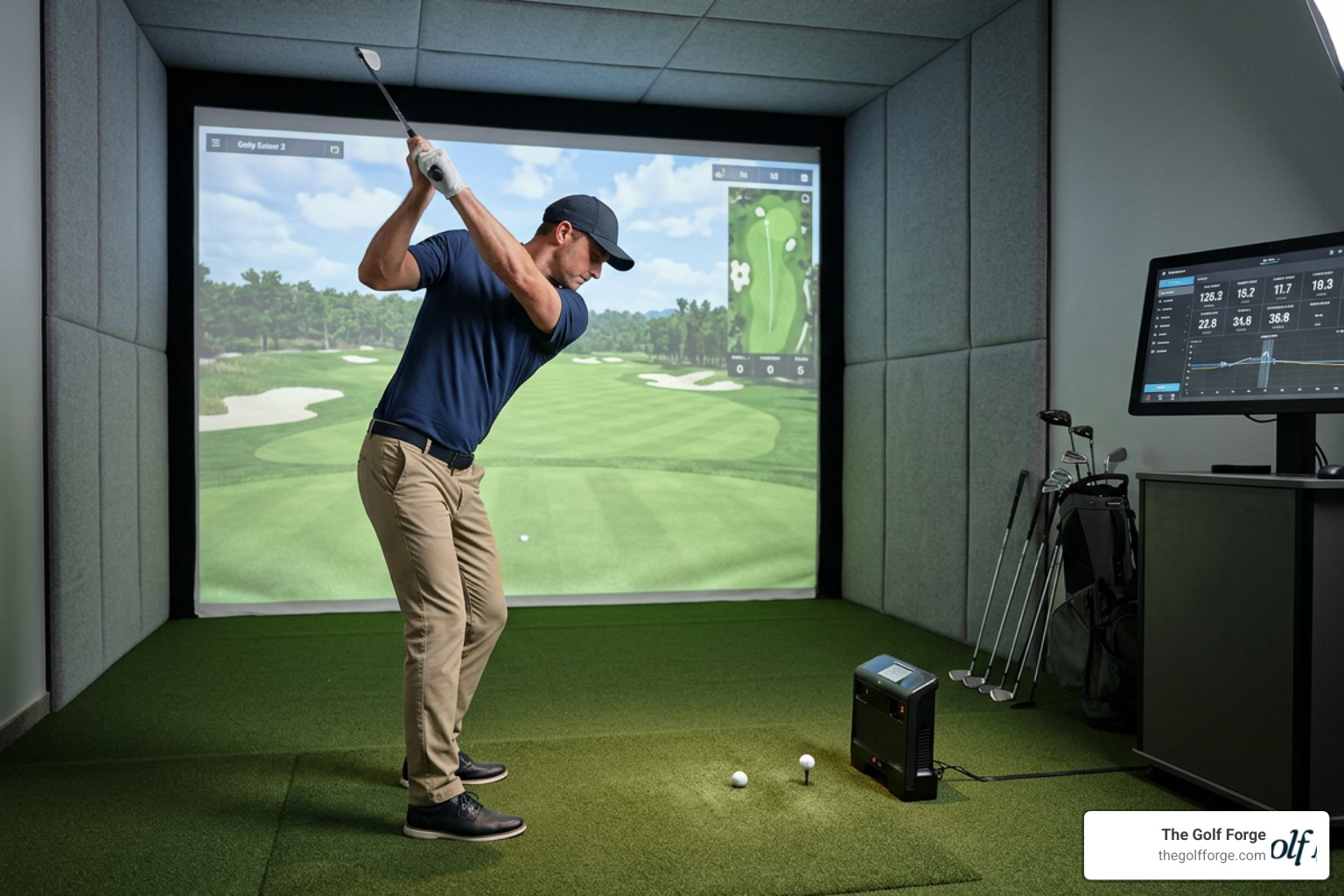
To get the absolute most out of your indoor practice, nothing compares to hitting real, premium golf balls. Professional indoor simulator facilities use standard golf balls because advanced launch monitors are calibrated specifically to track their exact weight, dimple patterns, and high-velocity spin.
For the ultimate indoor experience, manufacturers have even developed radar-optimized real balls. The TRK-R Golf Balls by TaylorMade, for example, feature a specialized, asymmetrical liquid silver pattern beneath the cover. This technology allows indoor radar-based tracking systems to instantly capture precise spin rates and flight paths without sacrificing the Tour-level speed and feel of a standard TP5 or TP5x.
By practicing with real balls, you ensure that the data captured by a high-end Golf Launch Monitor is 100% accurate, allowing you to make meaningful adjustments to your swing.
How Practice Balls Compare to Real Balls on Simulators
To understand why real balls are the gold standard for indoor training, it helps to compare how different ball types perform under scrutiny:
Performance Metric Foam Practice Balls Limited-Flight Balls Real Premium Golf Balls Feel at Impact Soft, mushy; no clubface feedback Decent spring-back; loud sound Authentic compression and feedback Launch Monitor Compatibility Poor; most camera systems cannot track Low; non-standard shapes confuse sensors Perfect; fully compatible with all monitors Data Accuracy Extremely low (often guessed) Moderate (only for visual flight) 100% accurate spin, speed, and launch Noise Level Very quiet; ideal for home Moderate to loud whirring Loud crack; requires professional baffling
For high-end, camera-based launch monitors like the Foresight Falcon, the system relies on high-speed cameras capturing thousands of frames per second to track the dimples and markings on the ball. When you hit a foam ball, the lack of distinct dimple shadows and the abnormal speed profile make it impossible for the system to calculate accurate spin axis or backspin.
Furthermore, while some entry-level home systems only measure clubhead data (estimating ball flight based purely on how fast the club was moving), this only gives you half the picture. It completely ignores face angle at impact, strike location, and dynamic loft.
Trying to keep noise levels down at home by using foam balls means sacrificing your practice quality. To truly understand your Golf Simulator Experience, you need the real deal.
Frequently Asked Questions About Indoor Golf Practice Balls
Do foam practice balls work with launch monitors?
In short, no. Most high-quality, commercial-grade launch monitors cannot track foam balls accurately. Because foam balls are incredibly light, they exit the face at abnormal speeds and fail to spin like a real urethane-covered ball. While some basic infrared systems that only track club path can estimate a shot, any camera- or radar-based system will either fail to register the shot entirely or provide highly inaccurate data.
Can you use real golf balls in an indoor simulator?
Absolutely! In fact, you should only use real golf balls in a simulator if you want accurate feedback. Professional facilities are specifically engineered with heavy-duty impact screens, padded turf, and protective side walls to absorb the force of real golf balls safely. This allows you to practice with the exact ball model you use on the course, ensuring your distances and spin rates translate perfectly to the outdoor game.
Are practice balls safe for indoor walls and windows?
Foam and plastic practice balls are completely safe for drywall and windows, which is why they are so popular for casual backyard or living room swings. Real golf balls, however, carry immense kinetic energy and can easily cause severe damage or injury if hit indoors without professional-grade netting and impact screens. This is why booking a session at a dedicated simulator facility is much safer and more practical than attempting a high-risk DIY setup at home.
Elevate Your Training at The Golf Forge
If you are tired of hitting inaccurate foam balls into a net and guessing where your shots are going, it is time to upgrade your practice routine. While there are other indoor options in the area, they don't offer the same combination of 24/7 private access and elite technology.
At The Golf Forge, we provide the ultimate indoor training environment. With private, 24/7-accessible bays in South Jordan and West Jordan, UT, you can practice on your own schedule using real golf balls and state-of-the-art Foresight Falcon launch monitors. Our technology captures precise, tour-level data on every single shot, helping you dial in your distances and correct swing flaws with confidence.
Whether you want to practice solo, work with our professional swing coaches, or enjoy a premium Golf Bay Rental with friends, we have a membership tier designed for you. Stop guessing at your game's progress and start seeing real results.
Discover how a data-driven approach can transform your Golf Simulator Outcome, find the Best Golf Simulator for the Price through our memberships, and Book Your Session Today at The Golf Forge!