

Golf Swing Plane Analysis: Finding Your Perfect Path
Why Golf Swing Plane Analysis is the Key to Consistent Ball Striking
You hit a perfect shot. Then the next one flies 30 yards right. Then a snap hook. Sound familiar?
Inconsistent ball flight is one of the most frustrating problems in golf — and more often than not, the root cause is swing plane. When your club travels on the wrong path through the swing, every shot becomes a guessing game. You can't fix what you can't see.
That's exactly where golf swing plane analysis comes in.
Here's what you need to know right away:
Swing plane is the angle and path your club travels around your body during the swing
A steep plane (too vertical) typically causes pulls, slices, and deep divots
A flat plane (too horizontal) typically causes pushes, hooks, and thin contact
The ideal plane roughly matches your shaft angle at address — about 60–65° for a 7-iron, and 55–60° for a driver
You can analyze your swing plane using slow-motion video filmed from a down-the-line camera angle
Small plane errors — even just a few degrees — can completely change your impact pattern and ball flight
Getting this right matters more than almost any other swing fix. As one instructor put it, if you've ever watched a coach point at a video and say "your club is way outside the plane" while you nodded along wondering what they meant — this guide is for you.
The good news? You don't need expensive 3D motion capture equipment to start understanding your swing plane. You need the right camera angle, the right checkpoints, and ideally, real-time feedback from a launch monitor and a trained eye.
At The Golf Forge's private indoor simulator bays in South Jordan and West Jordan, UT, golfers work with swing coaches and the Foresight Falcon launch monitor to get precise, data-backed feedback on exactly this — year-round, in a controlled environment, on your schedule.
But first, let's make sure you fully understand what swing plane is and how to spot problems in your own swing.

What is the Golf Swing Plane and Why Does It Matter?
At its simplest, the swing plane is the imaginary surface on which your golf club travels during a swing. Think of it as a giant, angled pane of glass resting on your shoulders and extending down to the ball.
If your clubhead, shaft, and hands stay on or close to this glass pane throughout your swing, you are "on plane." If your club breaks through the glass or drops too far below it, you are "off plane."
Why does this matter so much for your scorecard? It all comes down to predictability.
When your swing plane is consistent, your club path naturally aligns with your target. This leads to pure ball striking, optimal energy transfer from your body to the ball, and a tight, predictable dispersion. To dive deeper into how this path works, check out this guide on Golf Swing Plane Analysis: Understanding the Path Your Club Takes.
The Science of Golf Swing Plane Analysis
The physics of a golf club are dictated by its design. Every club in your bag is built with a specific lie angle — the angle between the center of the shaft and the sole of the clubhead when grounded.
When you set up to the ball, your posture dictates the initial shaft angle. To return the clubface square to the ball at impact, your club must travel along a path that respects this built-in geometry.
If your swing plane deviates significantly from this natural angle, you have to make athletic compensations (like flipping your wrists or stalling your hips) just to make contact. These micro-adjustments are incredibly hard to time consistently under pressure.
By utilizing structured golf swing plane analysis, we can identify where your natural biomechanics are fighting the physical design of the club. Our indoor Golf Simulator Experience is designed to help you analyze these exact mechanical relationships in real time.
How Swing Plane Affects Ball Flight
Your swing plane directly dictates your club path through impact, which heavily influences your ball flight. When we look at launch monitor data, we pay close attention to several key metrics:
Face Angle: The direction the clubface is pointing at impact.
Launch Direction: The initial direction the ball starts relative to the target line.
Spin Rate: Off-plane swings often deliver glancing blows, creating excessive side spin (causing slices or hooks) and inconsistent backspin.
Smash Factor: The efficiency of energy transfer from the clubhead to the ball. On-plane swings strike the center of the face, maximizing your smash factor and total distance.
How to Analyze Your Swing Plane Using Video
You don't need a high-tech biomechanics lab to start analyzing your swing. In fact, you can get incredibly accurate insights using your smartphone. However, the accuracy of your golf swing plane analysis depends entirely on your video setup. A camera positioned just a few inches off-target will distort your swing plane lines, leading to a false diagnosis.

To get a perfect down-the-line view, follow these rules:
Tripod Placement: Place your phone on a tripod exactly 10 to 12 feet directly behind your target line.
Height: Set the camera lens at hand height (roughly waist-high).
Target Line Alignment: The camera must point straight through your hands toward your target. If the camera is too far behind your body or too far on the ball-line side, the swing plane will look artificially steep or flat.
Frame Rate: Record in slow motion. Use at least 120 frames per second (FPS), or 240 FPS if your device supports it, to prevent the club shaft from blurring at high speeds.
Key Checkpoints for Your Golf Swing Plane Analysis
When reviewing your swing video, we break the movement down into a sequence of positions, often referred to as the P-system (P1 to P10). When analyzing your plane, pay close attention to these vital checkpoints:
P2 (Takeaway / Club Shaft Parallel to Ground): The club shaft should point directly down your target line, and the clubhead should be slightly outside or directly in line with your hands.
P4 (Top of the Backswing): The club shaft should point parallel to your target line. If it points to the left of your target (for a right-handed golfer), you are "laid off" (flat). If it points to the right, you are "across the line" (steep).
P5 (Transition / Downswing Club Shaft Parallel to Ground): As you transition down, the club shaft should bisect your trail arm or run parallel to your original shaft angle at address.
P7 (Impact): Your hands and shaft should return closely to the initial plane angle, typically with a slight forward shaft lean.
If you struggle to spot these positions on your own, working with a professional Swing Coach can quickly demystify the video review process and pinpoint exactly where your sequence is breaking down.
Drawing Reference Lines on Your Swing Video
Once you have a clean down-the-line video, you can use a basic drawing tool to create visual reference guides.
The Shaft Plane Line: Draw a straight line starting from the hosel of your club, running directly through your shaft, and extending past your body at address.
The Shoulder Plane Line: Draw a second line from the ball extending through your trail shoulder.
The "V-Shape" (The Slot): These two lines form a visual V-shape. Throughout your swing, your club and hands should ideally travel inside this V-shape.
Spine Angle & Head Circle: Draw a line along your spine at setup and a circle around your head. If your spine angle shifts or your head moves excessively out of the circle during your turn, it will pull your club off-plane.
Common Swing Plane Faults: Steep vs. Flat
Most amateur golfers fall into one of two categories: their swing plane is either too steep or too flat. Both faults cause distinct, frustrating misses on the course.
Swing Plane Fault | Typical Cause | Impact Position | Typical Ball Flight | Divot Depth |
|---|---|---|---|---|
Steep (Too Vertical) | Arms lifting instead of body rotating; over-the-top transition | Club path moving left (out-to-in) | Slices, pulls, ballooning shots | Deep, heavy divots |
Flat (Too Horizontal) | Wrapping club around body; poor posture; stuck hips | Club path moving right (in-to-out) | Hooks, pushes, thin/fat contact | Shallow or non-existent divots |
The Steep Swing Plane (Too Vertical)
A steep swing plane is the most common fault among amateur golfers. It usually begins during the backswing when the arms lift the club vertically instead of the torso rotating around the spine.
In the transition, this vertical position forces an "over-the-top" move where the hands push outward, causing the club to slice across the ball from out-to-in.
This steep angle of attack chops down into the turf, resulting in deep divots, lost distance, and high, weak slices. To learn more about how to identify and correct this vertical fault, read up on the Swing Plane — Coach Harvey breakdown.
The Flat Swing Plane (Too Horizontal)
A flat swing plane occurs when a golfer wraps the club around their body too quickly during the takeaway. This "inside-and-low" movement gets the club stuck behind the body's rotation.
To make contact from this stuck position on the downswing, the golfer must slide their hips and flip their wrists at impact.
This flat, shallow angle of attack often results in thin contact, blocks to the right, or violent snap hooks to the left when the hands overcompensate.
One-Plane vs. Two-Plane Swings: Which is Right for You?
Not all professional golfers swing on the exact same plane. In the golf instruction world, swings are generally categorized into two main styles: the one-plane swing and the two-plane swing.
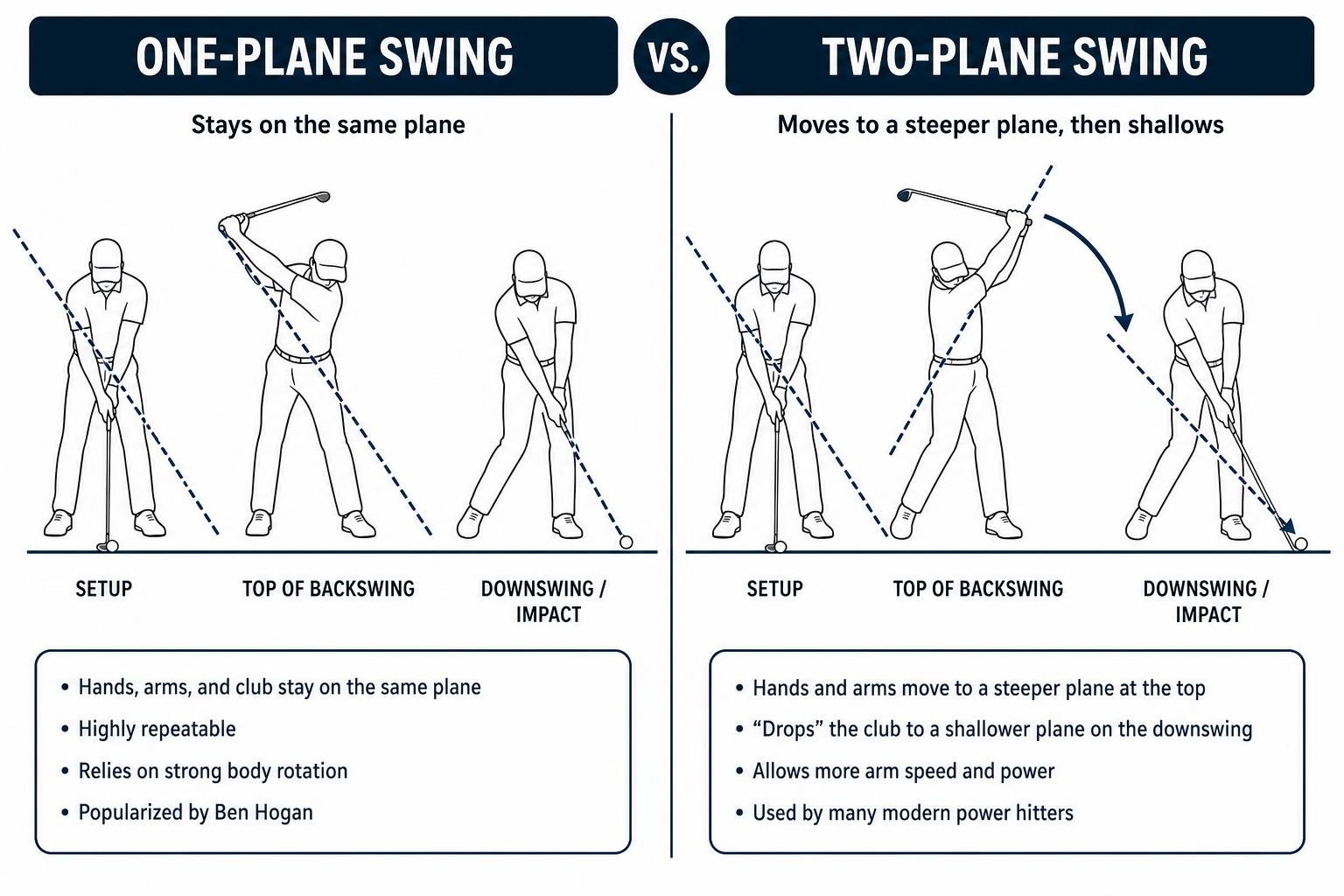
The One-Plane Swing: Popularized by legends like Ben Hogan, this swing keeps the hands, arms, and club on the initial shoulder plane throughout the entire motion. It is highly repeatable and relies heavily on aggressive body rotation.
The Two-Plane Swing: In this style, the hands and arms move more vertically, lifting above the shoulder line at the top of the backswing to create a second, steeper plane. The golfer then "drops" the club back down onto a shallower plane during the downswing. This style allows for more arm speed and can generate incredible power.
Physical Requirements for Different Swing Planes
Before you decide to pursue a specific swing plane model, it is vital to evaluate your physical capabilities. A one-plane swing, while highly consistent, requires exceptional core strength, hamstring flexibility, and forearm external rotation. If your body is tight, forcing a one-plane model can lead to injury.
On the other hand, a two-plane swing is often more accommodating for golfers with average flexibility, as it allows the arms to do more of the lifting.
If you are unsure which path suits your body type, our Golf Swing Coach Guide 2026 outlines how we assess physical mobility to design a customized swing plan that works with your natural movement patterns.
Mastering Golf Swing Plane Analysis with Modern Technology
Fixing your swing plane by "feel" alone is incredibly difficult. You need precise, objective feedback to calibrate your brain to what a correct swing plane actually feels like.

One of the simplest ways to train this is with alignment sticks. Placing an alignment stick in the ground at the same angle as your club shaft at address creates a physical barrier. If your swing is too steep, you will hit the stick; if you stay on plane, you will swing safely underneath or along it.
To accelerate this process, modern golf swing analyzer apps offer incredible visual feedback:
Swing Profile: This app automatically detects and records your swing hands-free, auto-drawing swing plane lines instantly. Named the Best Overall Product at the PGA Merchandise Show, users rate it highly (4.7 out of 5 stars across 1.6K reviews). You can download it on the Swing Profile Golf Analyzer - App Store - Apple or explore more at Swing Profile: Golf Swing Analyzer | Golf Swing Analyzer App.
SwingPlane AI: If you want to know if you are too steep or flat in under a minute, Swing Plane Analyzer - Know Your Swing in 60 Seconds uses advanced AI to analyze phone video, providing instant plane measurements.
SwingSmith: For those who want to compare their mechanics to the best in the world, Golf Swing Plane Analysis | SwingSmith analyzes data from over 550 PGA Tour professionals to show you exactly how your sequence stacks up against tour averages.
Combined with professional guidance from a coach using our Golf Coach Swing program, these tools turn abstract concepts into simple, actionable feel-based checkpoints.
Real-Time Feedback and Retesting
The secret to permanent swing changes is a tight feedback loop: swing, analyze, adjust, retest.
When you practice in a private bay at The Golf Forge, you aren't guessing where your ball went or what your club did. Our high-speed cameras and overhead Foresight Falcon launch monitors capture every single millisecond of your movement.
You can instantly view your swing plane lines side-by-side with your previous reps, allowing you to build muscle memory faster than you ever could at a traditional outdoor range.
Frequently Asked Questions About Swing Plane
What is the ideal swing plane angle for a driver vs. an iron?
Because a driver has a longer shaft and is set up further from your body, its ideal swing plane is much shallower — typically between 55° and 60°.
An iron is shorter and requires you to stand closer to the ball, resulting in a more vertical setup and a steeper ideal swing plane — typically between 60° and 65° for a 7-iron.
For context on setup geometry, the PGA Tour average driver setup angle is 78–82°. To learn more about how to measure and analyze these angles at home, check out The Proper Golf Swing Plane: How to Analyze Your Swing - Rotary Swing.
Can adjusting my posture instantly fix my swing plane?
Yes, absolutely! Many swing plane errors are actually posture errors in disguise.
If you stand too upright at address, your body will naturally swing the club on a steep, vertical plane. If you bend too far forward, your swing plane will flatten out.
Matching your spine tilt and hip hinge to the natural lie angle of the club at setup often corrects the swing plane without making any conscious mid-swing adjustments.
How does swing plane affect my total distance?
An off-plane swing is a major distance killer. When your club is too steep or too flat, it strikes the ball at a glancing angle rather than compressing it. This decreases your smash factor, increases unwanted side spin, and robs you of ball speed.
Getting your club back on plane ensures maximum energy transfer, instantly boosting your carry distance.
Conclusion: Take Control of Your Path Today
Understanding your swing plane is the single fastest way to transition from a golfer who relies on "timing" to a golfer who relies on solid, repeatable mechanics.
Stop spending your practice sessions guessing why you sliced the ball or hit it fat. By combining video analysis, modern training tools, and targeted drills, you can build a swing plane that delivers pure, compressed iron shots and straight, powerful drives.
At The Golf Forge, we provide the ultimate environment to master your swing. With locations in South Jordan and West Jordan, UT, our private 24/7 bays are equipped with industry-leading Foresight Falcon launch monitors to give you instant, hyper-accurate feedback on every swing.
Whether you want to practice on your own timeline, schedule a structured session with our expert swing coaches, or entertain clients with a corporate membership, we have the tools to help you succeed.
Ready to find your perfect swing path? Book your session at The Golf Forge Services or reserve your bay at our Golf Simulator South Jordan facility today!