

The 3:1 Ratio and Other Secrets to Perfecting Your Golf Tempo
Why Most Golfers Never Fix Their Swing — And How Tempo Training Changes Everything
You've spent hours at the driving range. You've watched the videos. You've tried the tips. But round after round, your ball striking stays unpredictable — and half the time, the weather shuts your practice down before you even find a rhythm.
That's exactly the kind of frustration that golf swing tempo training is designed to solve. And it's why golfers who train in a private, data-driven environment — with access to Foresight Falcon launch monitor feedback and professional swing coaches — tend to see results that outdoor range sessions simply can't deliver.
Here's the quick answer if you want it now:
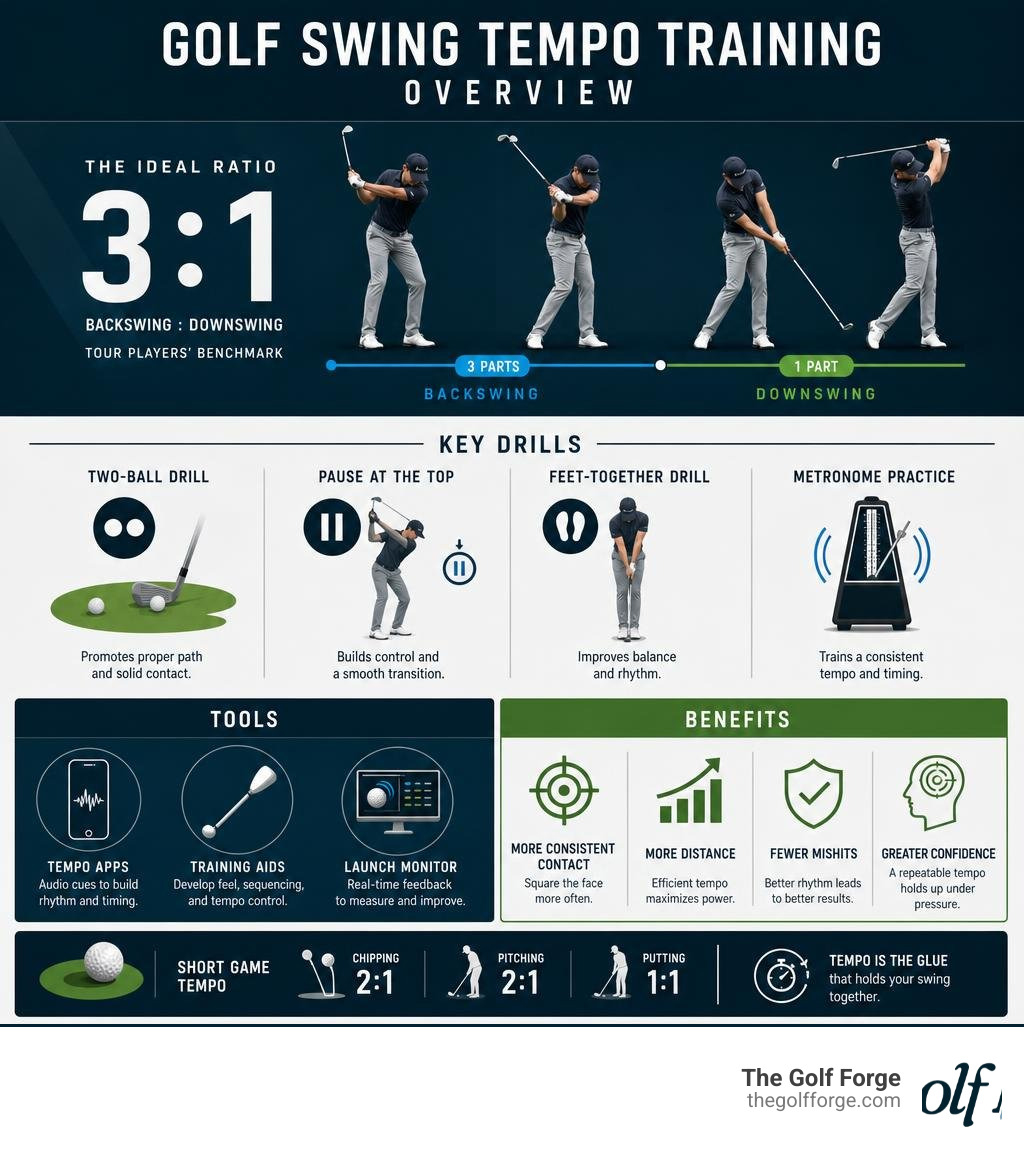
Golf swing tempo training at a glance:
What it is: Training your swing's rhythm — specifically the ratio of backswing time to downswing time
The benchmark: Tour players consistently use a 3:1 backswing-to-downswing ratio
Why it matters: Better tempo means more consistent contact, more distance, and fewer mishits
Key drills: Two-ball drill, pause-at-the-top, feet-together, metronome practice
Best tools: Tempo apps (audio cues), training aids (Orange Whip, TempoFix), and launch monitor data
Short game: Chipping and pitching often use a 2:1 ratio; putting closer to 1:1
Most golfers focus on swing mechanics — grip, path, position. But as Nick Faldo has described it, tempo is the glue that holds the whole swing together. Without it, even technically correct positions fall apart under pressure.
This guide covers everything: what tempo actually is, how to measure it, the best drills and tools, what the legends can teach you, and how to build a repeatable rhythm that holds up when it counts.
What is Golf Swing Tempo and How is it Measured?
To master your golf swing, you must first understand what tempo actually is—and what it isn't. Many amateur golfers confuse tempo with swing speed, but they are entirely different concepts.
Swing Speed: This is the physical velocity of the clubhead at impact, measured in miles per hour (mph). It dictates how much raw power you can potentially transfer to the ball.
Swing Tempo: This is the rhythm or timing of your swing. It is the relationship between the time it takes to complete your backswing and the time it takes to complete your downswing.
In other words, you can have a lightning-fast swing speed like Rory McIlroy or a smooth, languid swing speed like Fred Couples, yet both players can possess identical, perfect swing tempos.
Tempo is measured as a ratio of backswing time to downswing time. To track and analyze these speeds, golfers often use specialized metrics established by pioneering systems like Tour Tempo. By breaking down the swing frame-by-frame, coaches can pinpoint exactly where a player’s rhythm breaks down.
The Science of the 3:1 Ratio
Decades of high-speed video analysis of elite tour professionals have revealed an astonishing truth: regardless of their physical build, club selection, or overall swing speed, the world's best players swing with a consistent 3:1 backswing-to-downswing ratio.
This means the backswing takes exactly three times longer than the downswing.
This mathematical consistency is not a coincidence; it is rooted in the physics of the human body’s kinematic sequence. A proper kinematic sequence requires energy to transfer efficiently from the ground up: first through the hips, then the torso, the lead arm, and finally the clubhead.
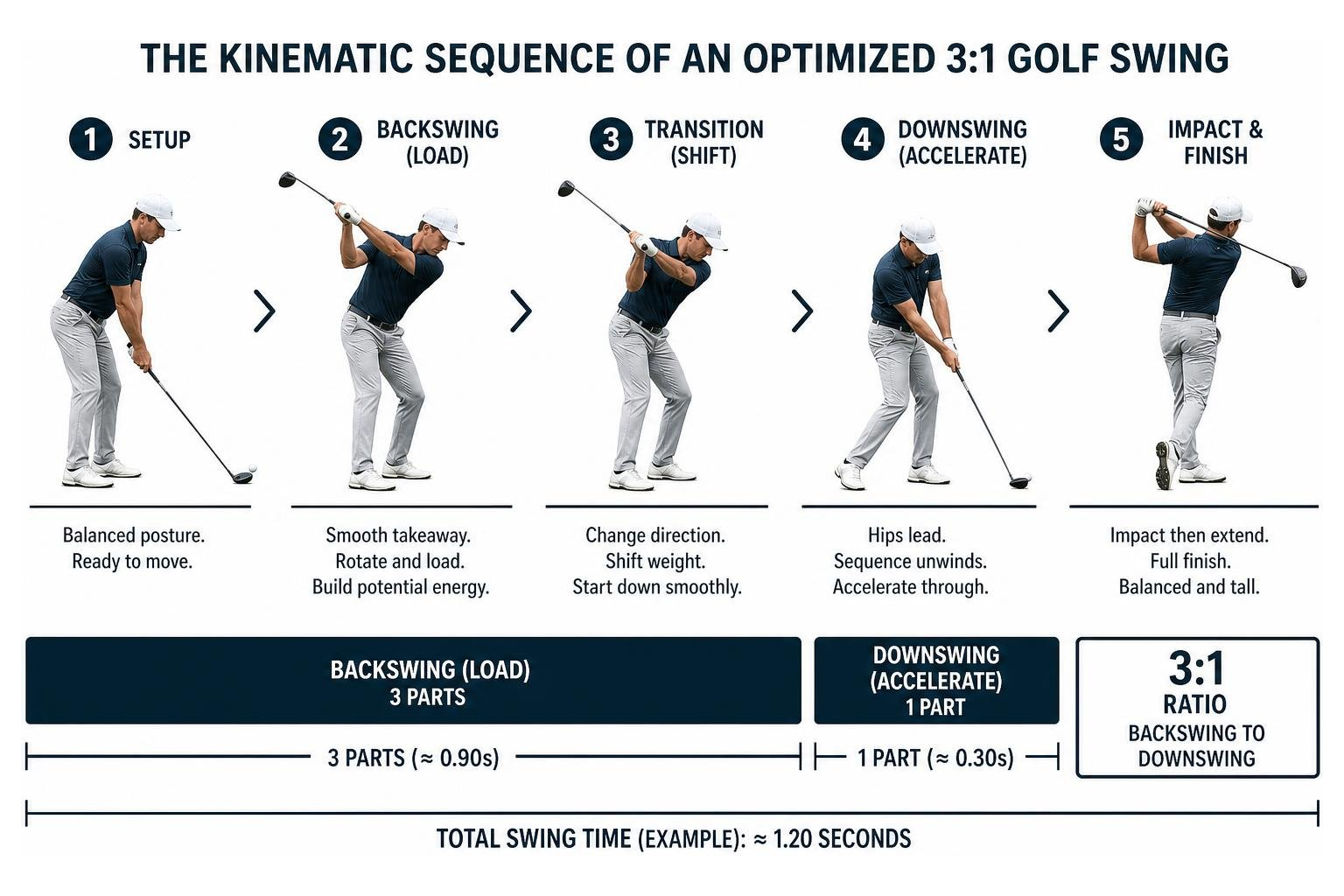
When your swing adheres to this 3:1 ratio, your muscles have the optimal amount of time to load, transition, and fire. If your backswing takes 0.90 seconds, your downswing should take precisely 0.30 seconds. If you are a faster swinger and your backswing is 0.60 seconds, your downswing must be 0.20 seconds to maintain that perfect 3.0 ratio.
Full Swing vs. Short Game Tempo
While the 3:1 ratio is the undisputed gold standard for full swings, your rhythm must adapt when you get closer to the green.
In the short game, the goal shifts from maximizing clubhead speed and lag to controlling distance and precision. Consequently, the ideal tempo ratio changes:
Chipping and Pitching (2:1 Ratio): For short-game shots around the green, a slightly quicker, more compact backswing is required. A 2:1 ratio keeps the arms and body connected, preventing the "deceleration" that leads to stubbed chips and blade-thinned pitches.
Putting (1:1 or 2:1 Ratio): Putting is entirely about pendulum control. Many great putters use an even 1:1 ratio (equal time back and through) or a gentle 2:1 ratio to ensure a smooth, unhurried stroke.
To practice these transitions seamlessly, many golfers turn to mobile technology. Using a specialized app like Tempo Town: Golf Swing Tempo App - App Store allows you to toggle between full-swing (3:1) and short-game (2:1) audio modes, training your nervous system to adapt to different shot requirements instantly.
Why Golf Swing Tempo Training is Crucial for Your Game
Without consistent tempo, even the most mechanically perfect swing will break down under pressure. When you step onto the first tee with a gallery watching, or try to carry a water hazard on the 18th hole, adrenaline spikes. Your natural instinct is to swing faster and harder. If you haven't trained your tempo, your transition will rush, your sequence will break, and disaster will follow.
Swing Metric Rushed Tempo (e.g., 2:1 or 1.5:1) Optimized 3:1 Tempo Clubhead Lag Lost early (casting/early release) Retained until right before impact Face Contact Inconsistent (heel, toe, thin, fat) Consistently centered on the sweet spot Ball Flight Slices, hooks, erratic trajectory Piercing, predictable draw or fade Distance Potential Low (wasted energy in transition) High (maximum kinetic energy transfer) Physical Strain High (over-muscling, risk of injury) Low (smooth, efficient muscle loading)
Common Tempo Mistakes and How to Correct Them
Most amateur golfers suffer from one of three primary tempo faults. Recognizing which one plagues your game is the first step toward fixing it:
The Rushed Takeaway: Out of a desire to generate power, many players jerk the club back away from the ball. This disconnects the hands from the torso early, throwing the entire club path off plane.
Casting and Early Release: When the downswing is rushed from the top, the hands try to force the club down too quickly. This causes "casting"—releasing the clubhead early and throwing away valuable lag. Most amateur golfers lose significant distance by releasing the club too early, which a tempo trainer can help correct by training the click at impact.
Deceleration (The "Decel" Fade): Often caused by fear of hitting a bad shot, a golfer will slow down their hands just before impact. Deceleration ruins ball compression and leaves the clubface wide open.
How Technology Accelerates Golf Swing Tempo Training
Trying to feel your own tempo is incredibly difficult. What feels like a smooth, slow swing in your mind might actually be a rushed, jerky motion in reality. That is where modern technology bridges the gap between feel and real.
Using the Golf Pro Tempo App - App Store gives you access to precise audio cues and frame-by-frame video analysis. You can upload a video of your swing, mark the address, top of the backswing, and impact positions, and let the app calculate your exact ratio.
At The Golf Forge in South Jordan and West Jordan, UT, we take this data-driven approach to the next level. Our private, weather-proof bays are equipped with state-of-the-art Foresight Falcon launch monitors.
Rather than guessing if your tempo is improving, the Foresight Falcon’s high-speed cameras capture real-time clubhead delivery, face angle, and ball data. When your tempo matches the ideal 3:1 ratio, you will see the immediate proof in your smash factor, ball speed, and carry distance on our simulator screens.
Top Drills and Tools for Golf Swing Tempo Training

Building a great tempo requires moving away from analytical, position-based swing thoughts and moving toward feel-based muscle memory. The goal of golf swing tempo training is to train your nervous system so that a smooth transition becomes your default reaction.
To see how these concepts look in motion, you can watch the BEST Golf Swing TEMPO DRILLS to STOP RUSHING ... - YouTube video, which demonstrates how to smooth out a hurried transition.
Essential Tempo Drills You Can Do Anywhere
You don't even need to be on a golf course to start improving your rhythm. These three classic drills can be practiced at home, in your backyard, or inside our private simulator bays:
The Two-Ball Drill: Place two golf balls about three inches apart, with one directly behind your clubhead and the other in its normal striking position. As you begin your takeaway, focus on smoothly rolling the rear ball straight back. If you rush your takeaway, you will flick or miss the rear ball entirely.
The Pause-at-the-Top Drill: Take your normal backswing, but force yourself to pause for a full one-second count at the top before starting your downswing. This completely eliminates the urge to rush the transition and forces your lower body to initiate the downswing first.
The Feet-Together Drill: Set up with your feet touching side-by-side and make smooth, 70% effort swings with a wedge or short iron. Because your base of support is so narrow, any sudden acceleration or rushed transition will cause you to lose your balance. This drill is highly effective for training a smooth, centered pivot.
Top Training Aids for Golf Swing Tempo Training
If you want to accelerate your progress, combining these drills with dedicated training aids is highly effective.
One of the simplest options is the Rhythm Roll® | Golf Swing Tempo Training Aid | Fits Any Club. This clever device slides directly onto your own club shaft, allowing you to train your sequencing and release timing through pure physical feel—without needing to overthink your mechanics.
For instant auditory feedback, the TempoFix - Swing Tempo Trainer is an exceptional tool. It features an internal weight system that slides down the shaft and produces a loud "click" at the point of maximum clubhead speed.
If you cast the club early, you will hear the click at the top of your swing. If you decelerate, the click will happen late. When your tempo is dialed in, the click will snap precisely at the impact position. In fact, a survey of 145 TempoFix customers found that 89% reported better lag retention, 84% more consistent contact, and 87% increased distance after using the tool.
Additionally, tools like the Tempo Swing | Master Your Golf Swing Tempo utilize highly responsive flex shafts. If your transition is too aggressive or jerky, the shaft will bend excessively and fight your hands. When you swing with a smooth, continuous flow, the shaft works in harmony with your body.
For golfers looking to explore further options, checking out a dedicated Golf Tempo Trainer | Improve Your Swing Rhythm & Timing can provide additional structured pathways to master your timing.
Leveraging Professional Coaching to Master Your Rhythm
While training aids and mobile apps are fantastic for daily practice, nothing replaces the trained eye of a professional coach. Trying to self-diagnose your tempo can often lead to "feel vs. real" errors—where you think you are making a smooth swing, but you are actually compensating for a mechanical flaw elsewhere.
The Role of a Professional Swing Coach
A certified instructor can look at your overall swing mechanics and help you integrate tempo training into your unique physical build. If you are looking to work with an expert, you can find a dedicated Swing Coach or explore our Golf Coach Swing options to get started. For a deeper dive into what to look for in an instructor, read our comprehensive Golf Swing Coach Guide 2026.
If you are located in Utah, finding local, top-tier instruction is incredibly easy. You can book structured, data-driven lessons with vetted professionals right in your neighborhood:
Find vetted instructors via Golf Lessons in South Jordan, UT | TeachMe.To
Connect with premier coaches through Golf Lessons in South Jordan, UT | Vetted Coaches
Browse local experts at Golf Lessons in West Jordan, UT | TeachMe.To
By working with a coach inside our private indoor bays at The Golf Forge, you get the best of both worlds. Your coach can analyze your physical movements while our Foresight Falcon launch monitors provide instantaneous, objective data on how your tempo changes are affecting your ball flight.
Adapting Your Tempo: Legends, Weather, and Aging
Your tempo is your swing’s unique fingerprint. While the 3:1 ratio is the universal benchmark, how that ratio looks in action depends heavily on your personality, physical build, and the conditions you are playing in.
Lessons from the Legends
We can learn an immense amount by studying the distinct, beautiful tempos of golf's greatest players:
Ben Hogan: The epitome of metronomic precision. Hogan spent countless hours on the range grooving a highly disciplined transition, proving that repeatable tempo is the ultimate key to ball-striking consistency.
Fred Couples: Famous for his incredibly relaxed, "syrupy" rhythm. Couples features a distinct, subtle pause at the top of his swing, allowing his lower body to clear and generate effortless, explosive power without ever looking rushed.
Ernie Els: Nicknamed "The Big Easy" for a reason. Els uses his tall stature and wide swing arc to create massive clubhead speed through a languid, unhurried tempo that looks completely effortless.
Jack Nicklaus: Nicklaus utilized a highly deliberate, patient takeaway. This slow start allowed him to create massive torque and maintain absolute control over the clubhead before unleashing his power at impact.
Adjusting for Conditions and Longevity
A mature golfer knows that tempo must adapt to external realities.
When you are playing outdoors in high winds, rain, or cold weather, your natural reaction is to tense up and swing harder. However, the secret to playing in adverse conditions is actually to slow down. Taking an extra club, widening your stance, and swinging at a smooth 80% tempo will keep your ball flight lower, reduce spin, and ensure solid contact.
Furthermore, as golfers age, physical flexibility and raw muscle speed naturally decline. Trying to maintain the aggressive, high-speed tempos of youth is a fast track to injury and frustration.
For senior golfers, focusing on an efficient, smooth 3:1 tempo is the ultimate secret weapon. By prioritizing timing and sequence over brute force, you can maximize your distance, protect your joints, and keep playing the game you love for decades to come.
Of course, the easiest way to avoid dealing with wind, rain, cold, or winter rust altogether is to train in a controlled environment. Practicing at The Golf Forge's indoor simulators in South Jordan and West Jordan allows you to maintain your perfect, consistent tempo 365 days a year, completely unaffected by Utah's unpredictable weather.
Frequently Asked Questions about Golf Swing Tempo Training
What is the difference between swing speed and swing tempo?
Swing speed is the actual velocity of your clubhead at impact (measured in mph). Swing tempo is the rhythm of your swing, specifically the ratio of time spent on the backswing compared to the downswing. You can have a very slow swing speed and still have a perfect 3:1 tempo.
Can I just slow down my swing to fix my tempo?
No! Simply trying to swing "slower" is one of the most common mistakes amateurs make. Slowing down your entire swing often leads to a disconnected, sluggish motion, causing you to leave the clubface open and lose significant distance. Instead of swinging slower, focus on the relationship between your backswing and downswing (the 3:1 rhythm).
How long does it take to see results from tempo training?
While many golfers feel a positive difference in contact and compression within their very first practice session using a tempo trainer, it typically takes about 21 days of consistent, daily practice (just 5 to 10 minutes a day) to build lasting muscle memory that holds up under course pressure.
Conclusion: Lock In Your Rhythm at The Golf Forge
At the end of the day, golf is a game of consistency. You can have the most technically beautiful swing positions in the world, but without a reliable, repeatable tempo, those positions will crumble the moment you step onto a real course.
If you are tired of inconsistent ball striking, frustrating range sessions, and letting bad weather disrupt your practice, it is time to take a structured approach to your game.
At The Golf Forge in South Jordan and West Jordan, UT, we provide the ultimate environment for mastering your swing rhythm. Our private, 24/7 indoor bays give you a quiet, distraction-free space to practice your drills. With advanced Foresight Falcon launch monitor technology tracking your every move, and elite swing coaches ready to guide your progress, you will finally build a swing you can trust.
Stop guessing at your rhythm. Ready to take your game to the next level? Book Now to reserve your private bay at The Golf Forge today!