
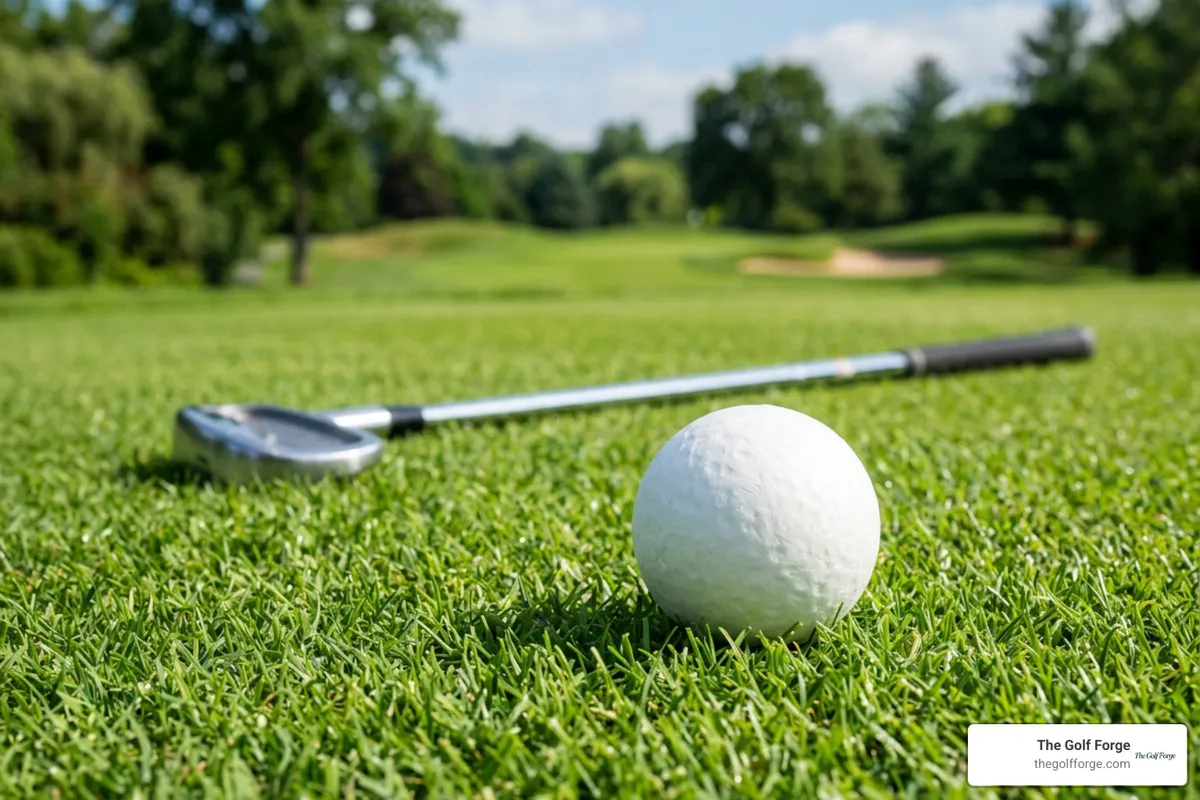
Callaway Foam Golf Balls Tested for Real Spin and Durability
Callaway HX Soft Flight vs. Assorted Basket Sets: Key Differences
There is nothing more frustrating than watching your hard-earned swing progress stall because bad weather or a packed schedule keeps you off the driving range. When you cannot get out to practice, maintaining rhythm and contact at home often feels impossible without risking broken windows or dented drywall. Callaway foam golf balls are a safe, limited-flight option for keeping your swing active at home when poor weather or limited range access interrupts your practice routine. Their soft EVA foam construction, regulation 1.68-inch size, and high-visibility colors provide useful contact and shot-shape feedback while greatly reducing the risk to walls, windows, and furniture compared with real golf balls. They are best for casual indoor chipping, backyard pitching, junior drills, and tempo work, but they are not a substitute for real-ball launch monitor data.
While stepping into private 24/7 simulator bays with Foresight Falcon launch monitors at The Golf Forge provides complete, data-driven validation, Callaway foam golf balls give players a convenient way to keep their swing moving between full practice sessions.
When shopping for foam practice options, golfers typically encounter two distinct packaging formats: the Callaway HX Soft-Flight Foam Practice Golf Balls, Orange, 9 Pack (also available in 18-packs or dual-dozen boxed sets) and the bulk-style Callaway Assorted Soft Flight Golf Balls in Basket.
While both options feature a regulation 1.68-inch diameter and soft foam builds, their intended use cases, packaging, and presentation differ considerably.
Feature | Callaway HX Soft Flight Sets | Callaway Assorted Basket Set |
|---|---|---|
Primary Container | Breathable mesh carry bag / box | Portable metal range basket |
Advertised Count | 9, 18, or 24 balls | 42 balls |
Color Options | High-vis neon (Orange, Lime, Pink) | Multi-color assortment |
Material Base | Soft-flite EVA Foam | Molded EVA Foam |
Dimple Structure | Patented HEX aerodynamic pattern | Standard round/hex pattern |
Approximate Price | $8.97 to $16.99 (varies by pack size) | $29.99 |
Target Golfer | Solo players focusing on specific drills | Families, junior clinics, volume practice |
Callaway Foam Golf Balls vs. HX Soft Flight Practice Sets
The standout technological feature of the HX series is Callaway's patented HEX dimple pattern. In premium real balls like the Chrome Soft TruTrack Golf Balls | Callaway Golf and Chrome Soft TruTrack Yellow Golf Balls | Callaway Golf, hexagonal aerodynamics minimize drag and stabilize lift.
Callaway molded that same geometric pattern into the soft-flite foam of the HX Soft Flight Practice Balls. In our flight tests, the structured surface prevents the erratic knuckle-ball drifting common with completely smooth sponge balls.
By contrast, the assorted basket sets prioritize quantity. These multi-color balls deliver an accessible, vibrant visual for fast retrieval in grass or living room carpets. They mimic standard dimpling well enough for target chips, though high-speed aerodynamic stability leans slightly in favor of the specialized Callaway HX Soft Flight - Foam Practice Golf Balls.
Quality Control, Pricing, and Basket Count Discrepancies
At a standard retail price point of $29.99 for 42 balls, the basket set seems like an undeniable bulk bargain. However, quality control audits reveal a recurring issue: multiple verified buyers report finding fewer than the advertised 42 balls upon unboxing, with some counts landing at 28 or even 16 units. If you pick up the metal range basket option, count the contents immediately to ensure you received the full set.
The boxed HX Soft Flight Practice Balls sets at $14.99 to $16.99 offer tighter packaging consistency and a breathable mesh bag that makes storage simple. When analyzing overall value, high-grade foam golf balls represent an inexpensive consumable, but missing inventory in unsealed baskets can quickly erode that cost-per-ball advantage.
Testing Callaway Foam Golf Balls: Flight, Spin, and Distance Metrics
Understanding how lightweight EVA foam translates swing input into ball flight is critical. Because foam balls weigh significantly less than a 45.9-gram regulation ball, air resistance impacts them immediately.

When struck with clean contact, Callaway foam balls produce an authentic initial trajectory that scales to approximately 60% of standard outdoor distance. Unlike standard plastic wiffle balls that drop straight down once their forward momentum stalls, these foam balls sustain backspin long enough to reveal your actual shot shape.
Metric / Characteristic | Standard Golf Ball | Callaway EVA Foam Ball | Perforated Plastic Ball |
|---|---|---|---|
Weight | ~45.93 g | ~7 to 10 g | ~4 to 6 g |
Travel Distance | 100% (Baseline) | ~60% of standard | ~15% to 25% |
Slice / Hook Feedback | Complete visual feedback | Clear directional curvature | Immediate fluttering drop |
Surface Impact Sound | Loud, crisp crack | Dull, quiet thud | Hollow plastic snap |
Window / Wall Risk | High (Destructive) | Minimal / Low | Minimal |
Wind Sensitivity | Moderate | Extreme | Extreme |
If your clubface delivers an open, out-to-in strike, the ball will show a definitive slice arc across your yard rather than masking the error. This makes them a reliable tool among golf practice balls with limited flight for casual feedback.
Launch Monitor Compatibility and Ball Speed Data
To see how foam translates under digital tracking, we tested Callaway foam balls alongside regular game balls like the 2025 Supersoft Yellow Golf Balls | Golf Balls | Callaway Golf and Callaway Supersoft MAX | Golf Balls | Callaway Golf.
Photometric and radar launch monitors can track Callaway foam balls, but the data must be interpreted with clear context:
Launch Angle: Foam compresses deeply against the clubface, often launching 2 to 4 degrees higher than a standard core ball on mid-iron strikes.
Ball Speed: Because the ball has minimal mass, measured ball speed drops substantially compared to real golf balls, skewing calculated clubhead speed algorithms on entry-level launch monitors.
Side Spin vs. Backspin: Optical sensors pick up the high-contrast dimples for initial directional line, but reading precise RPM backspin on EVA foam is inconsistent.
For simple contact confirmation and rough trajectory tracking, practicing with indoor golf practice balls at home has its perks. However, algorithms designed around solid-core compression cannot turn a 9-gram foam ball into pinpoint simulator data.
Durability Assessment: How Callaway Foam Golf Balls Hold Up Under Driver Impact
We subjected Callaway foam balls to repetitive strikes across multiple club categories to test structural resilience.
Short Irons and Wedges: Excellent lifespan. Wedges and short irons compress the foam gently without exceeding its tensile threshold. A single ball can easily withstand hundreds of wedge swings without losing shape.
Mid and Long Irons: Good durability. Moderate iron speeds cause slight cosmetic dimple flattening over extended practice sessions, but the core elasticity remains intact.
Driver Strikes (100+ mph swing speeds): Limited lifespan. Under full driver impact, the extreme compression stresses the molded seam. On average, a Callaway foam ball can withstand 50 to 75 full-power driver hits before developing micro-tears or splitting down the center line.
While they outlast brittle plastic options by a wide margin, they remain a consumable training aid under high-speed impacts.
Practical Training Applications: Backyard, Indoors, and Short Game
Because safety is the main reason players buy foam training equipment, these balls excel across several specific environments:
Living Room and Hallway Chipping: Weighing just a few grams, an errant blade with a sand wedge will bounce harmlessly off drywall, furniture, or baseboards without leaving dents. (Just keep them clear of fragile glassware!)
Backyard Pitching Drills: You can make full swings with a pitching wedge in a standard 40-foot yard without sending projectiles into the neighbor's patio.
Pool and Water Hazard Practice: Because EVA foam is naturally buoyant, these balls float cleanly on water. Golfers can chip toward floating targets or across swimming pools for low-pressure short-game practice and easily scoop them up with a net.
Junior Golf Introduction: With regulation 1.68-inch sizing and bright orange, pink, or lime colors, they are approachable for kids learning hand-eye coordination. Packaging carries safety warnings for children under 3 due to potential choking hazards if chewed.
When comparing training options, some golfers look at the denser composite design of Almost Golf balls, which hit harder and fly slightly further. However, for confined living quarters and family-safe drills, Callaway's softer EVA construction provides an extra layer of protection for regular indoor golf practice.
Training Limitations and When to Upgrade to Real Ball Simulator Data
Foam balls are great for quick backyard repetitions and grooving hand-path basics, but they have distinct performance boundaries. The soft foam prevents you from feeling true turf-and-strike compression. A fat iron shot that would dig into real turf and lose 40 yards can bounce cleanly off a home mat with foam, giving you a false sense of security about low-point control.
Furthermore, fine-tuning your game requires testing the exact ball you play on the course—whether that is a high-spin tour urethane model or an alignment-focused option like the Callaway ERC Soft Yellow | Golf Balls | Callaway Golf.
When you are ready to move past rough trajectory estimates and dial in your actual carry numbers, wedge spin rates, and smash factor, stepping into a dedicated golf practice facility is the logical progression.
At The Golf Forge, you practice with real golf balls in fully private, climate-controlled simulator bays. Powered by overhead Foresight Falcon launch monitors, our bays capture quadrascopic high-speed image data directly at the hitting zone. You see exact club path, face angle, impact location, and true ball flight down to single-digit RPMs—measurements that no foam ball can replicate.
Frequently Asked Questions About Foam Practice Golf Balls
Do Callaway foam practice golf balls float in water?
Yes. Ethylene Vinyl Acetate (EVA) foam has a closed-cell construction that is significantly less dense than water. The balls float high on the surface, making them well-suited for pool-side chipping targets and easy recovery during outdoor practice near ponds.
How far do Callaway foam balls fly compared to real balls?
Callaway foam balls travel roughly 60% of your normal distance on full iron swings, though this ratio decreases on higher-speed driver strikes due to rapid aerodynamic deceleration. A full 7-iron that normally travels 150 yards will generally fly between 40 and 60 yards in a yard setup.
Can foam practice balls damage indoor walls or windows?
Under standard iron and wedge speeds, Callaway foam balls absorb impact and rebound gently without breaking glass or leaving scuff marks on painted drywall. However, high-speed driver strikes at close range can still knock over picture frames, lamps, or delicate electronics, so sensible indoor clearance remains essential.
Conclusion: Maximizing Swing Gains From Casual Drills to Elite Studio Practice
Callaway foam golf balls hold a well-deserved spot in a golfer's home training kit. For casual warmups, living room chipping games with the kids, or maintaining swing tempo during rainy afternoons, their durable EVA foam and patented HEX dimple design deliver convenient, low-risk practice.
Yet when it comes to true swing development, guesswork only takes you so far. Developing genuine distance control, eliminating a persistent push-slice, and mastering clubface delivery requires authentic ball compression and tour-level measurement.
Take your game to the next level by trading foam estimates for precision tracking at The Golf Forge. With state-of-the-art locations in South Jordan and West Jordan, Utah, our 24/7 private simulator bays allow you to practice year-round on your own schedule. Train with real balls under overhead Foresight Falcon launch monitors, get customized guidance from professional swing coaches, or entertain clients and build team camaraderie with our flexible Corporate membership tiers.
Explore our Bronze, Silver, Gold, and Corporate memberships today, and experience the impact that data-driven indoor golf practice can make on your scorecard.