
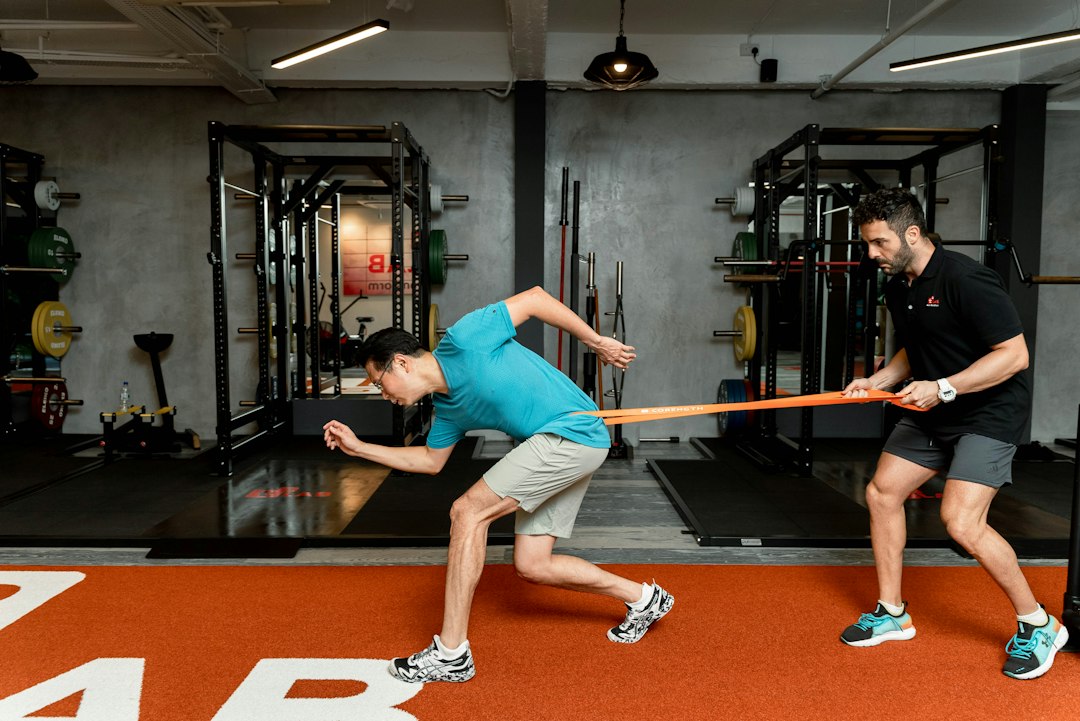
Stop Slicing and Start Squatting for Better Golf Swings
Golf Swing Improvement Exercises for a More Consistent Swing
You make a good swing on the range, then slice your next drive. When practice time is scarce, it is hard to tell whether the problem is your body, your swing, or both.
Start golf swing improvement exercises with 90/90 hip rotations and thoracic turns to loosen your turn. Add split squats and side planks for control, then try light resistance-band rotations for speed. These moves can support your swing, but they will not fix a slice on their own. At The Golf Forge, private 24/7 bays in South Jordan and West Jordan let you pair exercise with practice and use Foresight launch-monitor data to check what changes at impact.
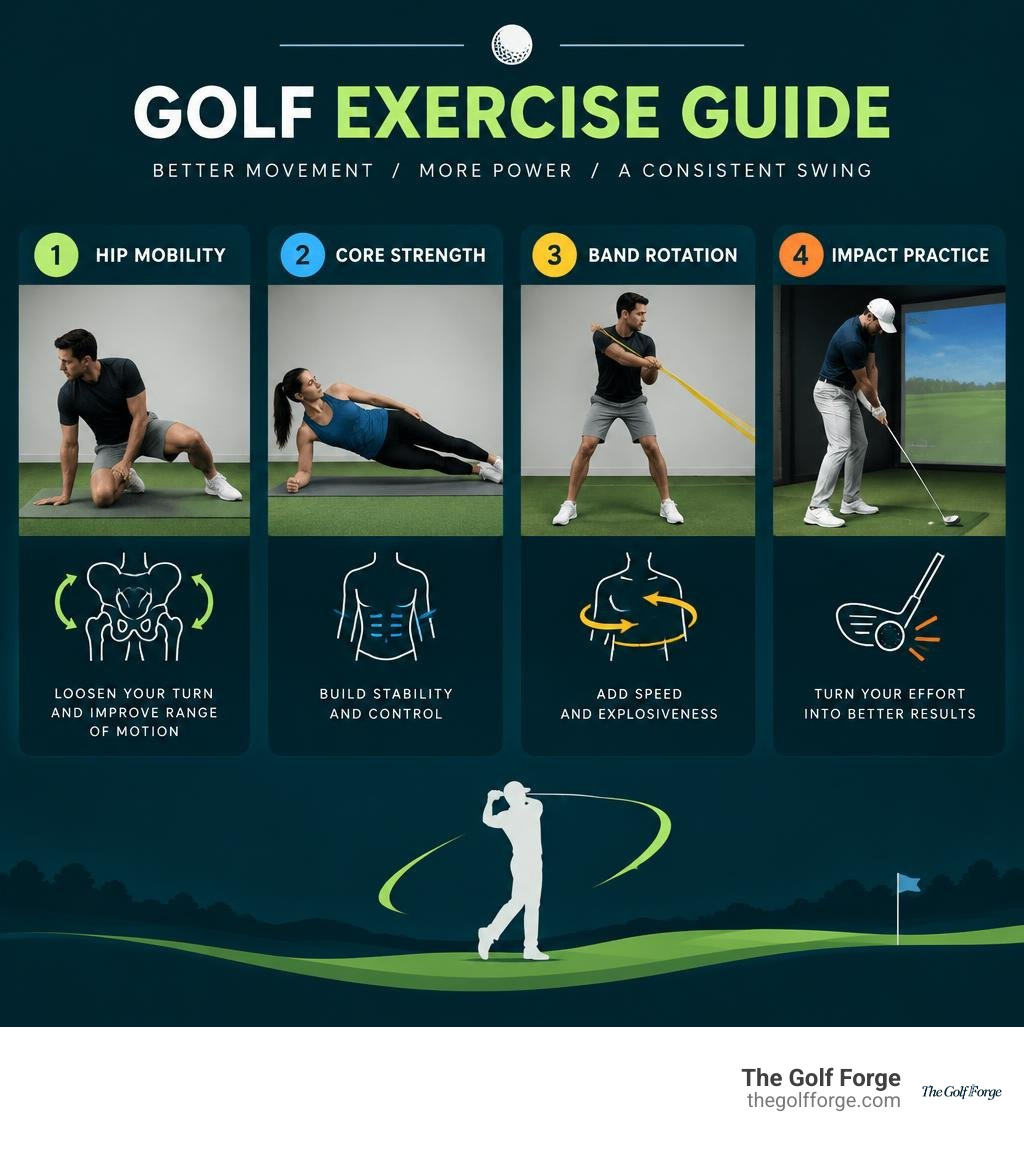
The Physical Pillars of Power: Mobility, Strength, and Rate of Force Development
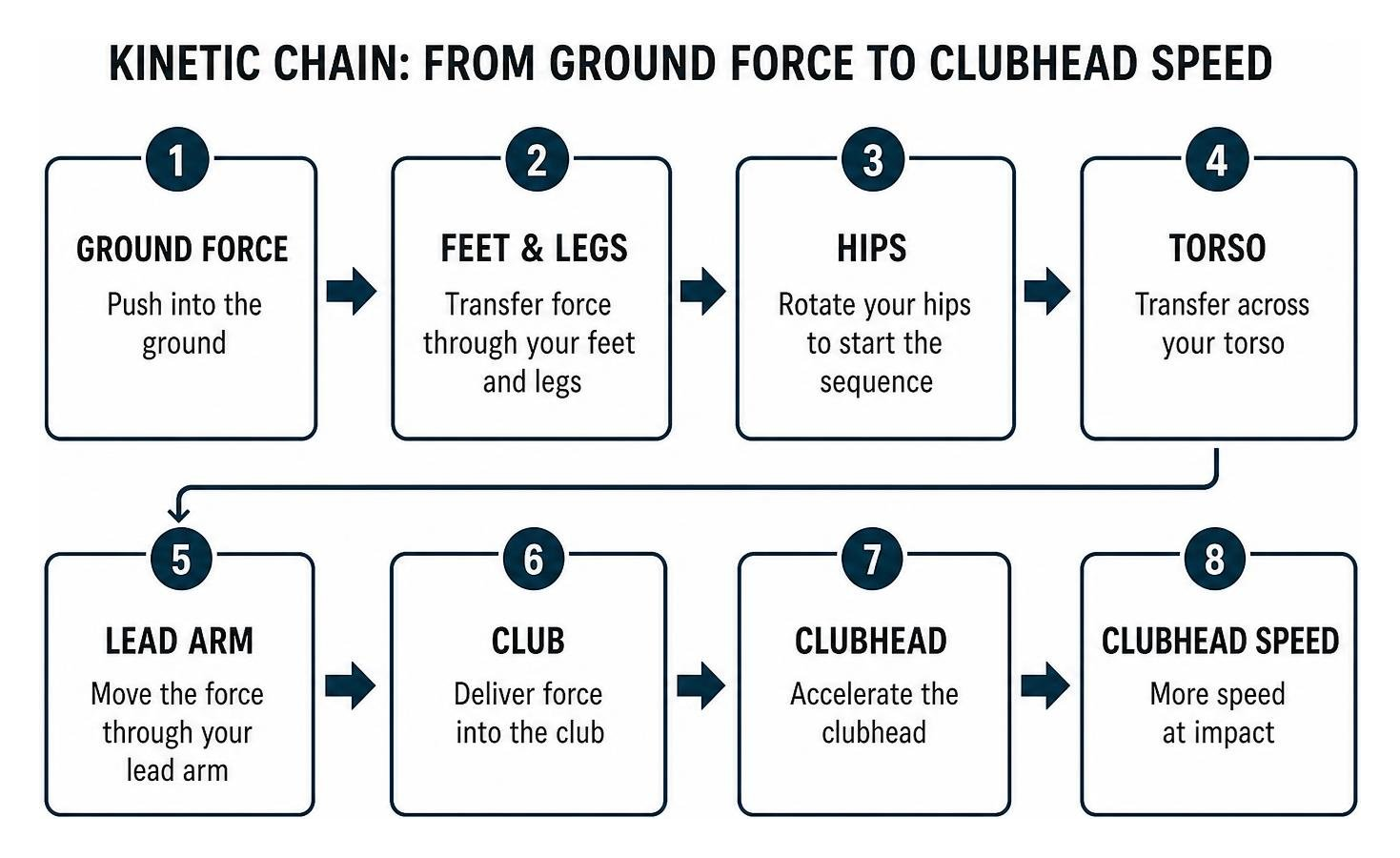
To build a repeatable, explosive swing, we have to look at the body as an interconnected kinetic chain. The swing does not start in the wrists or arms; it begins from the turf up. You push into the ground, transferring ground reaction forces through your feet, into your rotating hips, across your torso, through your lead arm, and out into the clubhead. If any link in that chain is weak or immobile, your sequence breaks down.
Achieving a genuine, comprehensive golf swing improvement requires understanding how mobility, raw strength, and speed work together. We follow a joint-by-joint approach: the ankles need mobility, the knees require stability, the hips demand deep rotational mobility, the lumbar spine needs rigid stability, the thoracic spine (mid-back) must rotate freely, and the scapular complex must stabilize the shoulders. Following scientific guidelines for golf strength training ensures you do not just build isolated muscle, but athletic movement patterns that seamlessly transfer to your swing.
Mobility vs. Strength: Building the Athletic Swing Foundation
Mobility is your ability to actively control a joint through its full range of motion, whereas strength is the maximum force you can apply against resistance. If you lack thoracic rotation or hip internal rotation, your brain will compensate by forcing your lower back to twist or sliding your hips laterally. This leads to costly swing faults like swaying and early extension.
At the same time, flexibility without strength leaves you unstable at the top of your swing. Unilateral strength exercises like split squats correct left-to-right muscular imbalances and train the pelvic stabilizers (the glute medius and adductors) to hold your spine angle through impact. Combining controlled hip CARs (Controlled Articular Rotations) with heavy unilateral resistance builds an unshakeable athletic base.
Physical Quality | Primary Purpose in the Golf Swing | Sample Exercise | Target Adaptation |
|---|---|---|---|
Maximal Strength | Force capacity, posture stability, joint protection | Split Squats, Dumbbell Rows | 5–8 reps @ heavy resistance |
Rate of Force Development | Fast energy transfer, clubhead acceleration | Med Ball Slams, Band Rotations | 3–6 reps @ max velocity |
Active Mobility | Full backswing coil, unrestricted follow-through | 90/90 Hips, Thoracic Rotations | 8–10 slow, controlled reps |
Developing Rate of Force Development for Maximum Clubhead Speed
Raw strength sets your power ceiling, but Rate of Force Development (RFD) determines how quickly you can express that force during the downswing, which takes less than one-third of a second. If you cannot recruit muscle fibers rapidly, high maximal strength will not translate into clubhead speed.
Following a structured 4-week functional golf power protocol trains fast-twitch motor units through explosive jumps, ballistic push-ups, and rotary medicine ball throws. Research shows that across 4 to 16 weeks of supervised explosive resistance training, athletes improve maximal strength by roughly 18% and RFD by nearly 27%. Developing this contractile impulse is what unlocks that extra 10 to 15 mph of swing speed.
Essential Golf Swing Improvement Exercises for Mobility and Power

Golf is a multi-planar sport requiring rotational power, lateral stability, and vertical thrust. Working with a dedicated swing coach helps pinpoint whether your misses stem from swing mechanics or physical limitations. Coupling coaching with multi-planar training ensures your body can execute the positions your coach asks for, keeping your mechanics stable across every round.
Core and Hip Golf Swing Improvement Exercises
The glutes and deep core musculature are the primary engines of the golf swing. Performing golf swing improvement exercises that target hip separation and anti-rotation stability will keep your pelvis locked in posture while generating massive rotational torque:
Single-Leg Glute Bridges: Lie on your back, bend your knees, lift one foot off the floor, and drive through the planted heel to full hip extension. Squeeze the glute hard at the top for 2 seconds. Perform 3 sets of 10 to 12 reps per side to eliminate pelvic tilt issues during transition.
90/90 Hip Rotations: Sit on the floor with both legs bent at 90-degree angles (one lead leg in external rotation, one trail leg in internal rotation). Keeping your chest tall, rotate your knees over to the opposite side without using your hands for support. Do 2 sets of 8 to 10 fluid transitions.
Half-Kneeling Pallof Press: Anchor a resistance band at chest height. Drop into a half-kneeling stance (inside knee down). Hold the handle with both hands at your sternum and press directly forward, resisting the band's urge to twist your torso. Hold for 2 seconds, return, and repeat for 3 sets of 10 reps per side.
Side Plank with Leg Lift: Prop up on your forearm in a side plank, keeping your body in a straight line. Raise your top leg 6 to 12 inches while engaging your glute medius. Hold for 20 to 30 seconds per side across 3 sets.
Thoracic Spine and Pivot Exercises for Golf Swing Improvement
Restricted mid-back mobility causes golfers to lift their arms instead of coiling their upper torso, ruining swing plane and leading to an over-the-top move. You can evaluate this path using detailed golf swing plane analysis to verify that your thoracic turn is on plane.
Kneeling Thoracic Rotation: Start on all fours, then sit your hips back onto your heels to lock out the lumbar spine. Place one hand behind your head and rotate your elbow up toward the ceiling, exhaling as you reach the top. Complete 3 sets of 10 reps per side.
Thread the Needle Stretch: From a quadruped position, slide your right arm underneath your left armpit, lowering your right shoulder and temple to the floor. Hold for 3 to 5 deep breaths to decompress the upper back and improve rotation.
Wall Open Books: Lie on your side with your top knee resting on a foam roller at a 90-degree angle. Extend both arms straight out in front of you. Keeping your knee pinned to the roller, sweep your top arm up and across to the opposite floor, opening your chest completely. Complete 2 sets of 10 reps per side.
Banded Pivot Drill: Stand in your golf posture with a resistance band looped around your lead shoulder and anchored low in front of you. Turn into your backswing pivot, feeling your trail hip load while your thoracic spine turns against the band's tension. Complete 3 sets of 10 reps.
Targeted Drills and Exercises to Correct Common Swing Faults
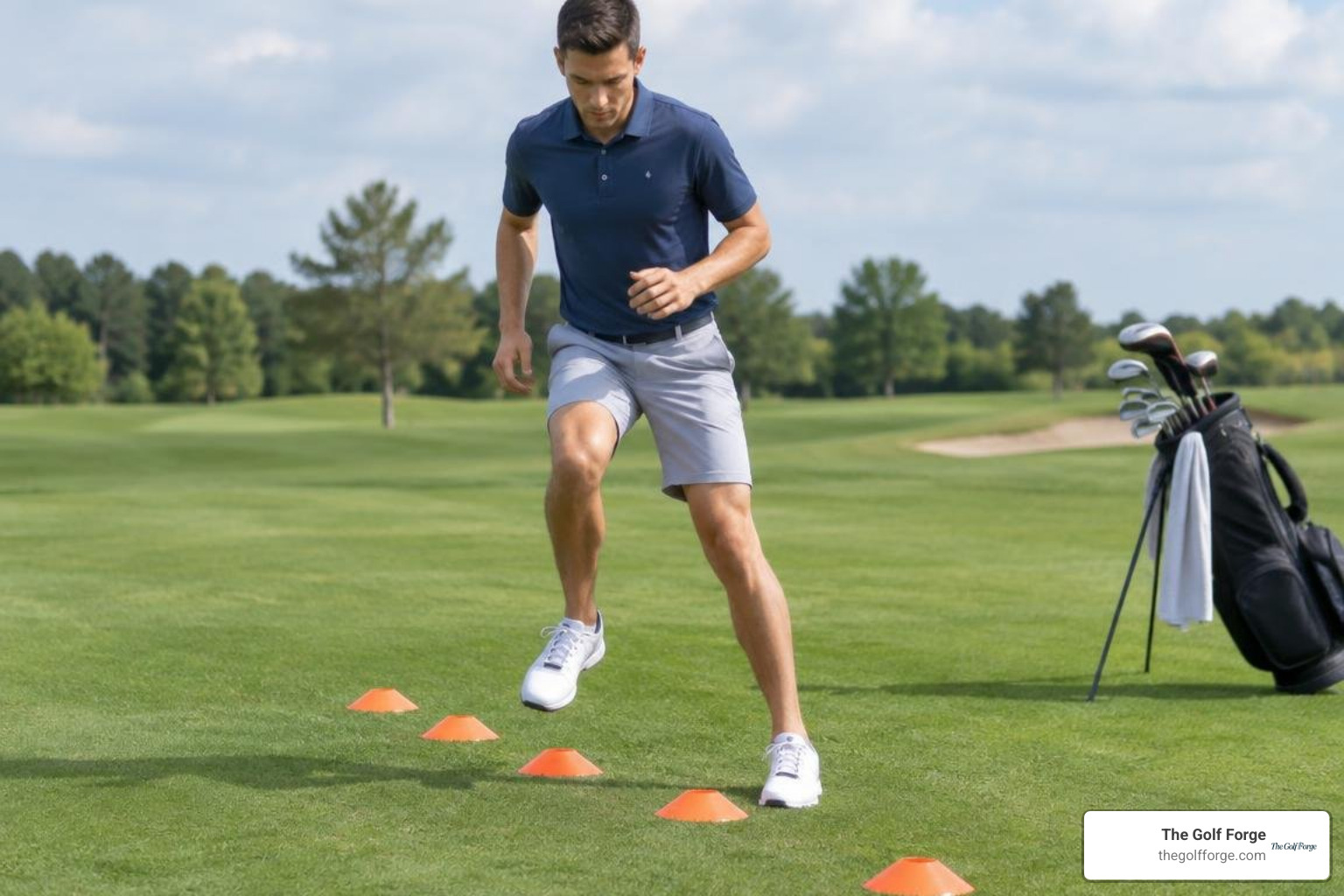
When amateur golfers struggle with consistency, physical drills help rewire motor patterns faster than endless ball-beating on the range. Proper body mechanics naturally lead to better golf swing tempo training because the body learns to move in rhythm rather than rushing the hands.
Eliminating Early Extension and Sway with Resistance Bands
Early extension occurs when your hips move toward the golf ball during the downswing, forcing your spine to stand upright and resulting in weak blocks or violent hooks. Swaying happens when the hips slide laterally outside the trail foot rather than rotating inside your foot's footprint.
The Early Extension Ender: Loop a heavy resistance band around your waist and anchor it behind you. Step forward into your golf posture until there is moderate tension pulling your hips back. Make slow-motion practice swings, ensuring your glutes push backward against the band's resistance through transition and impact.
The Hip Station Drill: Place an alignment stick or foam roller 1 inch outside your trail hip at address. Turn to the top of your backswing. If your trail hip bumps the stick, you are swaying rather than rotating your pelvis around your spine.
Dr. Kwon Biomechanical Step Drills: To train dynamic ground forces, try practicing biomechanical step drills for ground force. Start with your feet close together, rock the club forward to waist height, take a 5-inch step back as you start your backswing, and take a 5-inch step forward toward the target just as your backswing completes. This sequences hip pressure and eliminates lateral sliding.
Mastering Impact Mechanics and Wrist Control
Did you know that an estimated 94% of shots hit by amateur golfers fall short of the green? This statistic highlights how poor impact mechanics and loose clubface control rob players of intended carry distances. Adding dedicated wrist mechanics and clubface control drills ensures your body's power translates directly into clean contact:
The Motorcycle Drill: At the top of your backswing, initiate your downswing by flexing (bowing) your lead wrist downward, similar to revving a motorcycle throttle. This closes the clubface early and prevents the high, weak slice caused by excessive wrist extension (cupping).
Foot Spray Strike Test: Spray dry foot powder or impact spray across your clubface and hit 10 shots. Check where the ball leaves its mark. Striking the heel or toe costs significant ball speed; adjusting your setup and hip depth quickly centers face contact.
Towel Ground-Contact Drill: Lay a small towel flat on the mat or turf about 3 to 4 inches behind your golf ball. Practice striking the ball cleanly without catching the towel on your downswing. This forces a forward low point and clean, ball-first compression.
Complete Workout Protocols: Warm-Up, Senior Modifications, and Weekly Periodization
A functional fitness routine must fit your schedule and adapt to your age and playing frequency. Combining structured workouts with focused indoor golf training keeps your body primed and your swing repeatable across every season.
Pre-Round Dynamic Warm-Up and Post-Round Recovery Routine
Never step onto the first tee cold. Spending 8 to 10 minutes performing dynamic movements activates the nervous system, lubricates joints, and prevents soft-tissue strains:
Opposite Heel Taps (10 reps each side): Stand tall, bring one heel up across your body to tap the opposite hand, opening the hips dynamically.
Hand Walk-Outs (5 to 6 reps): From standing, bend at the waist, walk your hands out into a push-up plank, hold for 1 second, and walk your hands back to your feet.
Standing Torso Rotations with Club (10 reps each side): Place a club across your shoulders, set your golf posture, and rotate fully back and through, emphasizing thoracic movement.
Post-Round Foam Rolling: Spend 5 minutes rolling the glutes, thoracic spine, and latissimus dorsi to reduce soreness and prevent tissue tightness.
Senior Golf Fitness and Low-Impact Adaptations
As golfers age, the rate of force development declines faster than maximal strength. However, this loss is completely reversible with the right training. Clinical studies show that older adults aged 80 to 89 who engaged in 12 weeks of explosive resistance training saw a 51% increase in RFD and a 28% increase in maximal strength, reducing their age-related RFD deficit against 60-year-olds from 43% down to just 15%.
Chair-Assisted Rotational Stretch: Sit tall in a sturdy chair, hold the backrest with both hands, and gently rotate your shoulders while keeping your knees facing forward. Hold for 10 seconds per side.
Low-Impact Dumbbell Box Squats: Sit down onto a chair or workout bench holding light dumbbells, then stand up explosively, driving through your heels. Complete 3 sets of 8 reps.
Single-Leg Balance Stands: Stand near a wall for safety, lift one foot 2 inches off the floor, and balance for 30 seconds per leg to strengthen the stabilizing muscles in your feet and ankles.
In-Season vs. Off-Season Weekly Training Schedules
Off-Season Protocol (Hypertrophy, Strength & Power):
Monday: Lower Body Maximal Strength (Split squats, deadlifts, glute bridges) + Core Anti-Rotation.
Wednesday: Upper Body Mobility & Power (Ballistic push-ups, med ball slams, single-arm rows).
Friday: Full-Body RFD & Speed Training (Box jumps, band rotations, driver speed sets).
In-Season Protocol (Maintenance & Durability):
Tuesday & Thursday: 30-minute full-body maintenance circuits combining mobility, single-leg bridges, and light rotational throws to stay sharp without causing muscle fatigue.
Tracking your speed and mechanics during both training phases at a dedicated golf practice facility ensures that your gym work translates directly into higher clubhead speed on the course.
Frequently Asked Questions About Golf Swing Improvement Exercises
How quickly can swing improvement exercises increase clubhead speed?
Most golfers see initial speed improvements within 4 to 6 weeks as their nervous system adapts and learns to recruit motor units more efficiently. Across a full 12-week program combining mobility, strength, and explosive rotational drills, dedicated players regularly gain 5 to 10 mph of clubhead speed, translating to 15 to 25 extra yards of carry distance.
What is the most effective home exercise for fixing early extension?
The banded hip hinge and glute wall touch drill are the most effective at-home exercises. Stand with your rear end 2 inches away from a wall in your golf posture. During your backswing, your trail glute should press against the wall; during your downswing, your lead glute should press firmly against the wall without your hips pulling away.
Can strength training make a golfer's swing too stiff?
Only if you train like a classic bodybuilder with isolated, heavy, slow movements without maintaining mobility. When you train like an athlete—incorporating multi-planar rotational exercises, full ranges of motion, and dynamic stretching—strength training actually increases your flexibility, swing width, and rotational freedom.
Conclusion
A slicing drive or inconsistent iron strike is rarely just a swing flaw—it is almost always tied to physical restrictions in your hips, core, and thoracic spine. By committing to targeted mobility drills, unilateral strength work, and explosive rotational exercises, you create an athletic foundation that protects your joints and unlocks effortless clubhead speed.
Experience the best way to validate your physical gains by training in Utah’s premier environment. At The Golf Forge, our private, 24/7 bays in South Jordan and West Jordan feature industry-leading Foresight Falcon launch-monitor technology, giving you exact data on ball speed, club path, and face angle. Whether you want to book a private session, work alongside an expert swing coach, or explore our Bronze, Silver, Gold, or Corporate membership tiers, visit The Golf Forge’s indoor golf simulator studios today to take your game to the next level.