

How to Improve Golf Swing Consistency in 3 Easy Steps
Why Golf Swing Improvement Feels So Hard (And How to Finally Fix It)
You've stood over the ball with the best intentions. You've watched the videos, tried the tips, and hit bucket after bucket at the range — only to play the same inconsistent round on Saturday. Golf swing improvement is one of the most searched topics in the sport for a reason: most golfers are putting in real effort but getting almost no return on it.
Here's the short answer if you want it fast:
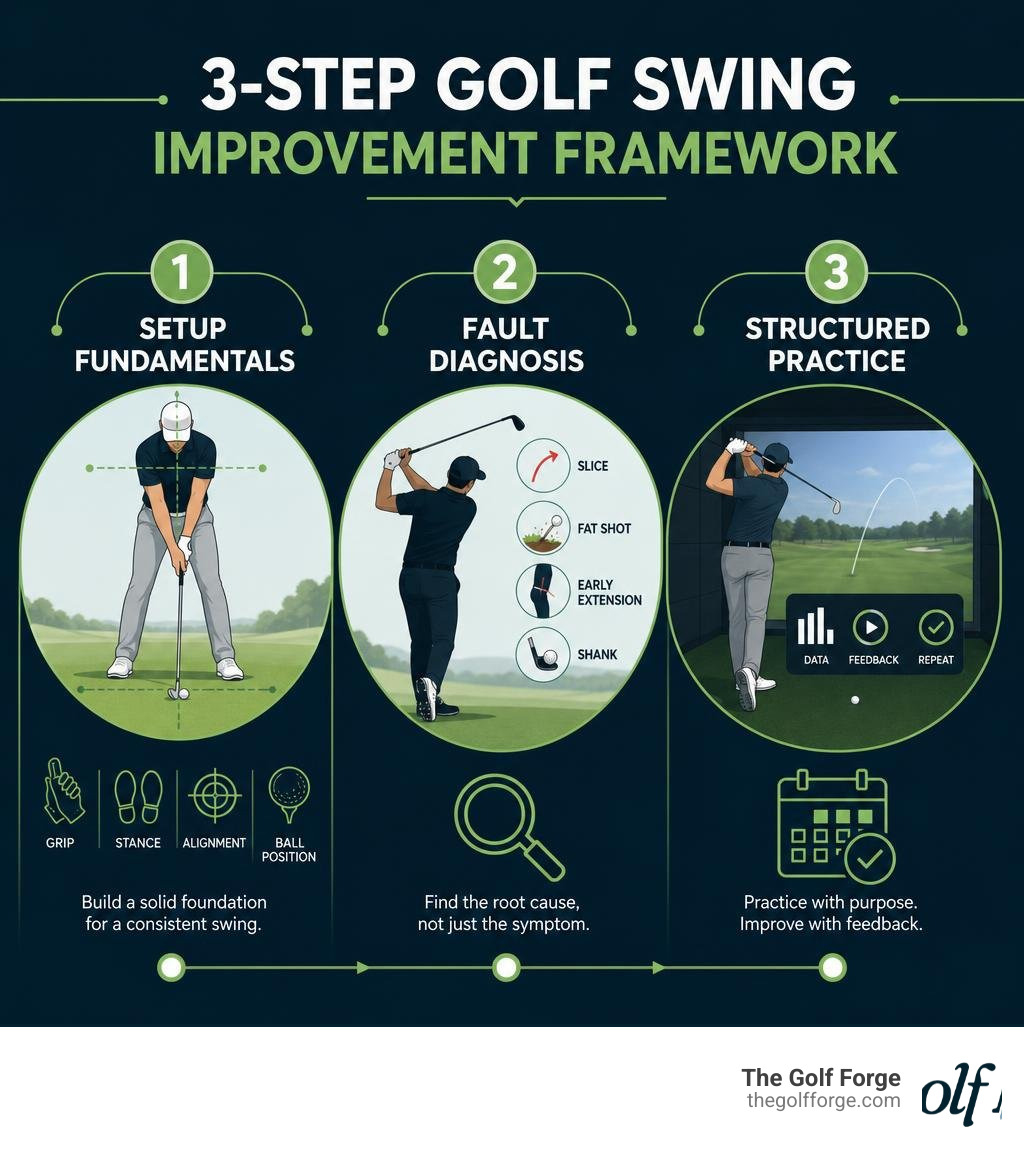
Master your setup fundamentals — grip, stance, alignment, and ball position
Diagnose your primary swing fault — slice, fat shot, early extension, or shank — and fix the root cause, not the symptom
Build a repeatable motion through structured, feedback-driven practice (not just more range balls)
That's the framework. The rest of this guide breaks down exactly how to do each step.
The frustrating truth? Most wasted practice sessions share the same problem: no feedback loop. As research into amateur swing patterns confirms, golfers who receive immediate, objective feedback improve 3 to 5 times faster than those practicing without it. Hitting balls and hoping something changes isn't practice — it's just repetition of whatever you're already doing wrong.
Weather cancels your range time. Crowded bays break your focus. And without a coach watching every rep, you have no idea if that swing change you're working on is actually happening — or if you're just feeling like it is.
That's exactly the gap that The Golf Forge was built to close. With private, climate-controlled simulator bays open 24/7 in South Jordan and West Jordan, UT, and Foresight Falcon launch monitor technology capturing real data on every swing, you get the feedback-rich environment that actually produces change — rain or shine, weekday or weekend.
Step 1: Master Setup Fundamentals for Golf Swing Improvement
Ask any elite golf coach, and they will tell you that a staggering number of swing issues are actually just setup and alignment errors in disguise. If your body is misaligned or your grip is compromised before the club even begins to move, your brain has to perform athletic gymnastics mid-swing just to guide the clubface back to the ball.
To build a repeatable swing, you must standardize your setup. We can break this down into four foundational pillars: grip, stance, alignment, and ball position.

Grip: Neutral and Repeatable
Your hands are your only connection to the golf club. If your grip is too "strong" (rotated too far to the trail side) or too "weak" (rotated too far to the lead side), the clubface will naturally want to twist during your swing.
The Grip Types: Choose between the interlocking, overlapping, or 10-finger (baseball) grips. Choose the one that feels most physically secure, but keep the hand relationship tight.
The "V" Indicator: For a neutral grip, the "V" shape formed by the thumb and index finger of both your lead and trail hands should point generally toward your trail shoulder.
Grip Pressure: Tension is the enemy of clubhead speed. If you squeeze the grip too tightly, you engage the muscles in your forearms and shoulders, which actively slows down your rotation. Think of Sam Snead’s classic advice: hold the club as if you are holding a delicate baby bird — tight enough that it cannot fly away, but light enough that you do not squeeze the life out of it.
Setup: Athletic, Stable, and Relaxed
A stable swing requires an athletic foundation. Stand with your feet roughly shoulder-width apart (slightly wider for drivers, narrower for short irons). Keep a soft bend in your knees, hinge forward from your hips while keeping your spine straight, and let your arms hang naturally down from your shoulders. Your weight should feel evenly balanced between your left and right foot, as well as distributed across the balls of your feet rather than back on your heels.
For a deeper dive into establishing this stable foundation during your practice sessions, check out our guide on Indoor Golf Practice.
Alignment: The Underrated Consistency Hack
It is incredibly easy to align your feet toward your target while your shoulders are pointing thirty yards to the left (or vice versa). When your body lines are crossed, your swing path is forced to cut across the ball, ruining your consistency.
To practice correctly:
Lay down an alignment stick parallel to your target line (pointing just left of your target for a right-handed golfer, like railroad tracks).
Place a second alignment stick perpendicular to the first to monitor your ball position.
Align your feet, knees, hips, and shoulders parallel to the target-line stick.
Crucially, check your forearms. Misaligned forearms are a hidden killer that can ruin your swing path even if your feet look perfect. Ensure your forearms run parallel to your target line.
For more visual checkpoints to dial in your setup, read The perfect golf swing: Guide to a stable and repeatable swing.
Ball Position: Keep It Simple
Standardizing where the ball sits in your stance prevents you from having to adjust your swing's low point on every shot.
Short Irons & Wedges: Play the ball directly in the middle of your stance.
Mid-Irons: Play the ball about one ball-width forward of center.
Fairway Woods & Hybrids: Play the ball two ball-widths forward of center.
Driver: Play the ball off the inside of your lead heel to ensure you hit upward on the ball.
Step 2: Diagnose and Fix Your Primary Swing Fault
Once your setup is locked in, the next step on the path to golf swing improvement is identifying what is actually happening when you swing. Most amateur golfers try to fix their swing by chasing superficial "symptoms" they saw in a YouTube video. If you want permanent results, you must address the biomechanical root causes.
Identifying Biomechanical Root Causes for Golf Swing Improvement
Every bad shot has a physical cause. Let’s look at the most common swing faults analyzed through modern biomechanical data:
1. The Over-the-Top Downswing (Slices and Pulls)
This is the most common complaint in golf. Biomechanical analysis of thousands of amateur swings reveals that in 73% of sliced swings, the root cause is an over-the-top downswing path. This occurs when the upper body (shoulders and arms) initiates the downswing before the pelvis has a chance to transition.
Instead of the club shallowing out, it gets thrown outward and cuts across the ball from out-to-in. To fix this, you must learn to let your lower body lead the downswing while your trail shoulder feels like it remains back.
2. Early Extension (The "Stand-Up" Move)
Early extension occurs when your pelvis thrusts forward toward the ball (closer to the target line) during the downswing. This fault is present in over 55% of golfers with handicaps above 15.
When your hips move forward, you run out of room for your arms, forcing you to "flip" your wrists at impact to make contact. The root cause is often a failure to create hip depth during the backswing. You must focus on coiling into your trail hip socket, feeling your trail hip pocket move backward and slightly down.
3. Excessive Head Sway (Fat and Thin Shots)
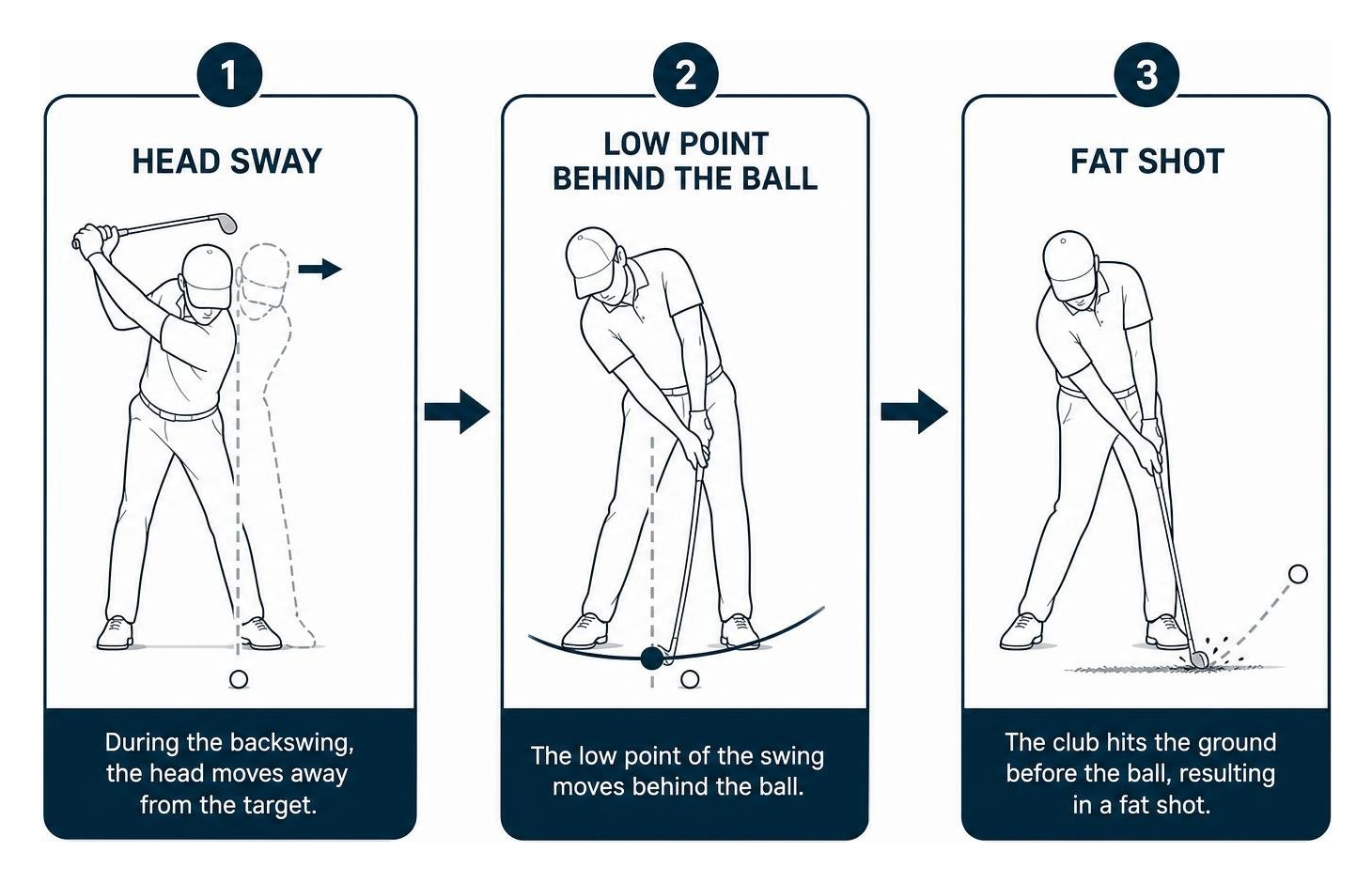
Do you struggle with hitting the ground before the ball? In 81% of fat-shot patterns analyzed, the golfer's head moved more than 2 inches away from the target during the backswing. Over 60% of amateur golfers struggle with this excessive lateral head sway.
If your head slides backward, the low point of your swing moves behind the ball. To hit a clean shot, you have to slide back forward perfectly — a timing act that is almost impossible to repeat. Keep your head centered over the ball, imagining your spine rotating around a fixed axis.
If you need professional eyes to help diagnose these complex movements, scheduling a session with an expert can make all the difference. Learn more about our coaching programs by visiting Golf Coach Swing and find out how a tailored plan can fast-track your progress.
For a comprehensive breakdown of how these faults interact with your body’s natural pivot, read the Complete Guide to Fixing Golf Swing Faults.
Using Data and Feedback to Cure Slices and Hooks
To truly understand your swing, you need to understand the ball flight laws. Every shot shape is determined by the relationship between two metrics: Club Path (the direction the club is traveling at impact) and Face Angle (the direction the clubface is pointing at impact).
The ball's start line is mostly determined by the face angle, while the curve of the ball is created by the face-to-path relationship.
Shot Pattern Ball Flight Description Biomechanical Root Cause How to Fix It The Slice Starts left (or straight) and curves aggressively to the right (for right-handed players). Out-to-in swing path with a clubface that is open relative to that path. Close your stance in practice, feel your trail shoulder drop down, and swing inside-out. The Hook Starts right (or straight) and curves aggressively to the left. In-to-out swing path with a clubface that is closed relative to that path. Often caused by stalled hip rotation (less than 35° open at impact). Keep your lower body rotating through impact, letting your belt buckle face the target at the finish. The Fat Shot Club strikes the ground before making contact with the ball. Head sways more than 2 inches away from the target on the backswing; weight stays on the trail foot. Keep your head centered. Shift 60% of your weight to your lead side at setup to move the swing's low point forward. The Shank Ball shoots violently to the right off the hosel of the club. Pelvis moves toward the target line (early extension), pushing the club outward. Place a soft object (like a headcover) just outside the ball and practice swinging to miss the headcover.
When you practice in our private bays at The Golf Forge, our Foresight Falcon launch monitors measure these face-to-path relationships down to a fraction of a degree. This removes all the guesswork. Instead of wondering, "Why did that ball curve?", you can look at the screen and instantly see the exact face-to-path numbers.
For more tips on how to stop guessing during your practice sessions, check out Golf Swing Feedback: How to Stop Practicing Without Knowing What Changed. You can also explore how modern tracking systems score your movement patterns in Golf Swing Mechanics: The 7 Checkpoints AI Uses to Score Every Rep.
Step 3: Build a Repeatable Motion with Structured Practice
Once you have diagnosed your primary swing fault, you must build a repeatable physical motion. This is where motor learning science comes into play. To change a movement pattern permanently, you cannot simply swing at 100% speed while trying to hit a ball. Your brain will automatically default to its old, comfortable habits.
Slow-Motion Drills and Tempo Training for Golf Swing Improvement
The secret to making a swing change stick is removing the dual-task conflict of trying to hit a ball while changing your mechanics. The best way to do this is through slow-motion practice.
The 4-Second Backswing Drill: Take a very slow backswing lasting roughly four seconds. Pause at the top of your swing to feel your body's position. This gives your brain time to map the new muscle movements without rushing.
The Transition Pause: The transition sequence happens too quickly to consciously think about at full speed. Practice your transition in slow motion: let your lower body begin to shift and rotate toward the target while your upper body and arms remain passive.
The "Whip" Sequence: Think of your body as the handle of a whip and your arms/club as the lash. If you pull the handle (your pelvis and core) first, the whip cracks at the bottom naturally. Trying to force lag with your hands only creates tension and ruins your tempo.
To understand how practicing in slow motion can accelerate your progress, read the insights in Stop wasting your time. This is the right way to start making a swing change.
Once you have mapped the correct sequence in slow motion, you can begin to integrate it into your natural swing tempo. To learn how to balance your swing timing, check out our guide on Golf Swing Tempo Training.

A 14-Day Practice Plan for Rapid Muscle Memory
You don't need to spend hours on the range to see massive improvement. In fact, shorter, highly focused sessions are far more effective for building muscle memory. Here is a structured 14-day practice plan designed to fit into 20 to 30 minutes per day:
Days 1–3: Setup & Alignment Calibration
Spend 15 minutes practicing your setup routine in front of a mirror or in a simulator bay.
Use alignment sticks for every shot.
Hit 20 easy half-swings focusing purely on maintaining a neutral grip and a stable, centered head position.
Days 4–7: Slow-Motion Biomechanical Mapping
No full-speed swings allowed.
Perform 30 reps of the 4-Second Backswing Drill with a pause at the transition.
Focus entirely on correcting your primary swing fault (e.g., coiling deep into your trail hip to stop early extension).
Review your body positions after every rep.
Days 8–11: Block Practice with Feedback
Begin hitting balls at 60% to 80% speed.
Practice in a private bay where you can see your launch monitor data after every shot.
If your data shows your club path is moving in the right direction, maintain that physical feel. If it reverts, slow down your speed.
Days 12–14: Random Practice & Pressure Testing
Switch to random practice to translate your new swing to the golf course.
Change your club and target on every single shot.
Go through your full pre-shot routine for each swing.
Track your start line and balance. If you can hold your finish in balance until the ball lands, your sequencing is on track.
When practicing on a simulator, it is crucial to practice with a clear goal in mind. To learn how to make every indoor session count, read about establishing a Golf Simulator Intention.
Frequently Asked Questions About Golf Swing Improvement
How long does it take to fix a golf swing fault?
With immediate, high-quality feedback, most golfers can measurably improve a single swing fault within 50 to 100 quality repetitions. However, converting that change into permanent muscle memory typically requires 300 to 600 feedback-verified reps.
The key is consistency and feedback; practicing without knowing what changed simply reinforces your old, incorrect habits.
Why does my practice swing look better than my real swing?
This is a classic psychological phenomenon known as dual-task conflict. When you make a practice swing without a ball, your brain has only one goal: execute the movement pattern.
The moment you place a ball on the ground, your brain introduces a competing goal: make clean contact with the ball. To guarantee contact, your nervous system automatically defaults to your most deeply ingrained coordination patterns, overriding the new swing feel you were trying to practice.
To bridge this gap, you must remove the ball initially, practice in slow motion, and slowly introduce the ball at slow speeds.
Can I improve my golf swing without a private coach?
Yes, absolutely. While working with a coach is highly beneficial, you can make incredible progress on your own if you have access to objective feedback loops. Traditional self-teaching fails because golfers rely on "feel," which is notoriously unreliable in golf.
By utilizing high-speed video analysis, launch monitor data (such as club path and face angle), and structured practice routines, you can act as your own swing coach.
To learn how to utilize modern tools to self-coach effectively, check out our Swing Coach portal and read our comprehensive Golf Swing Coach Guide 2026.
If you do decide you want professional guidance in Utah to supplement your practice, working with a dedicated instructor in a private, data-rich environment is the fastest way to see results. At The Golf Forge, we offer access to expert swing coaches who can analyze your launch monitor data and help you build a customized improvement plan right in our South Jordan and West Jordan locations.
Conclusion: Elevate Your Game at The Golf Forge

At the end of the day, golf swing improvement isn't about finding a magic tip; it's about creating a consistent, distraction-free environment where you can practice with real data.
At The Golf Forge, we provide exactly that. Our indoor golf simulator locations in South Jordan, UT and West Jordan, UT feature private, climate-controlled bays open 24/7 to our members.
Equipped with advanced Foresight Falcon launch monitors, our bays capture precise club and ball data on every single swing. This means you can practice at 10:00 PM on a rainy Tuesday, see your exact face-to-path numbers, and know with 100% certainty whether your swing is improving.
Whether you are looking for a place to run through your 14-day practice plan, work with one of our swing coaches, or host a corporate event that your team will actually talk about, we have a membership tier designed for you.
Stop guessing. Start improving. Book Now to reserve your private bay at The Golf Forge, or learn more about our coaching options at our Swing Coach page. If you want to check out our facilities first, read about our Golf Practice Bay South Jordan UT, get a feel for our premium Golf Simulator Experience, and learn how to analyze your Golf Simulator Outcome to lower your scores for good.