

Ultimate Checklist for Scratch Golf Clubs
The Fastest Path to Becoming a Scratch Golfer Starts Indoors
You've been grinding at the driving range for months. But rain wipes out your sessions, daylight runs out, and your swing still feels inconsistent when it actually matters. Sound familiar?
A scratch golf club setup isn't just about the sticks in your bag — it's about the entire training environment that shapes how you use them. Most golfers plateau not because they lack talent, but because they lack consistent, data-driven practice.
Here's a quick answer for what makes a scratch golf club setup work:
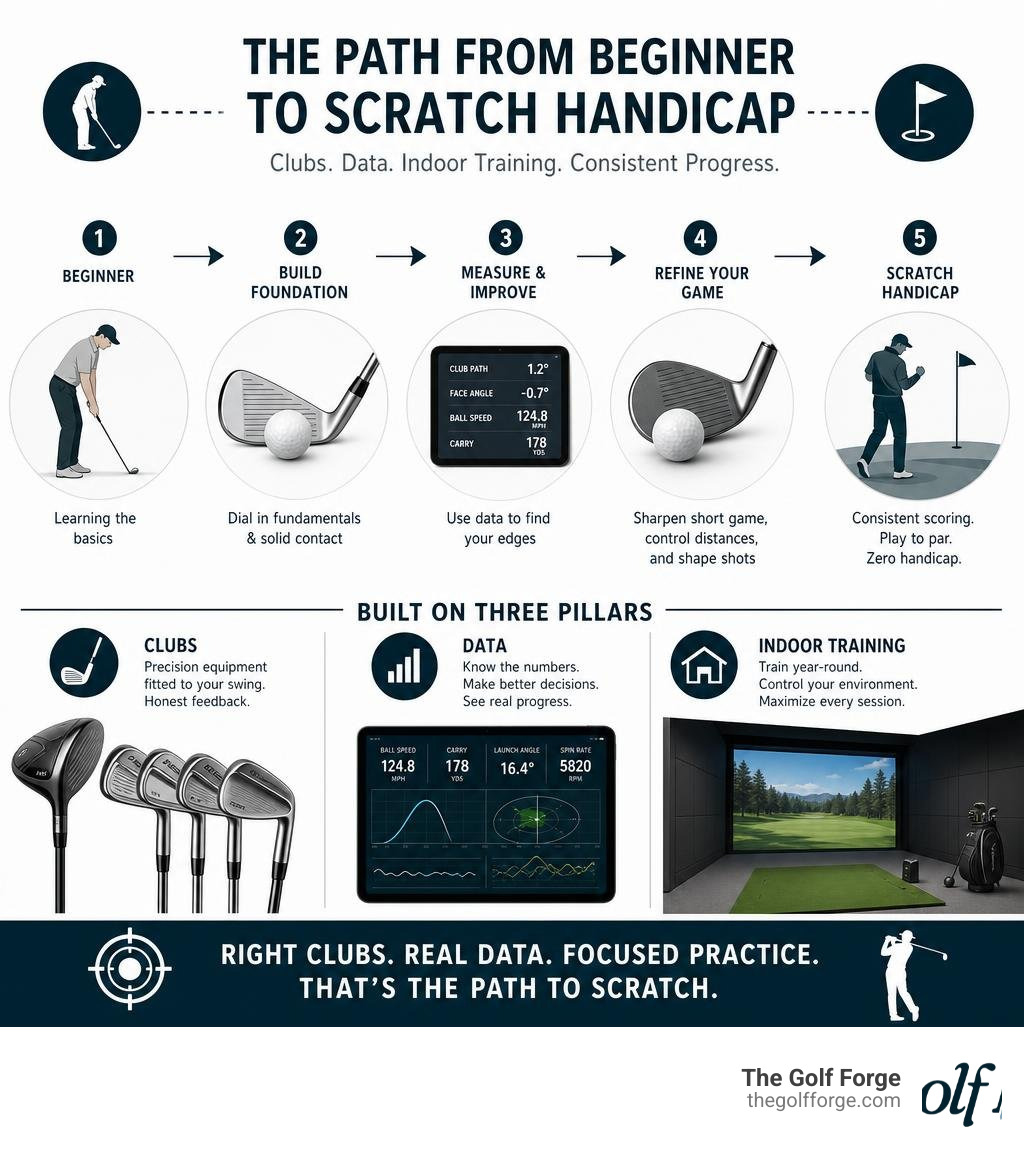
Zero handicap goal — A scratch golfer plays to a course handicap of 0 and shoots around par consistently
Player's irons — Blades or minimal-cavity irons that reward precision and give honest feedback
Wedge control — Dialed-in spin rates and launch angles for every distance
Accurate shaft fitting — Flex and weight matched to your actual swing speed
Data-driven practice — Knowing your club path, face angle, ball speed, and carry distance for every club
The good news: you don't need perfect weather or a tour card to train like a pro. Private indoor simulator bays — like those at The Golf Forge in South Jordan and West Jordan, UT — give you access to Foresight Falcon launch monitor technology 24/7, so you can build the consistency scratch golf demands on your schedule.
This checklist will walk you through exactly what to look for in scratch-level clubs and how to test them properly using real data.
What is a Scratch Golfer and What Equipment Do They Need?
To understand what kind of scratch golf club setup belongs in your bag, we first have to understand the standard of a scratch golfer. By USGA definition, a scratch golfer is a player who can play to a course handicap of zero on any rated course.
But what does that look like in terms of raw physical benchmarks?
For male scratch golfers: The standard benchmark is an average tee shot distance of 250 yards at sea level, with the ability to reach a 470-yard hole in two shots.
For female scratch golfers: The standard benchmark is an average tee shot of 210 yards, with the ability to reach a 400-yard hole in two shots.
In Utah, our high elevation naturally adds a bit of distance to those drives, but the core requirement remains the same: absolute precision and elite course management. A scratch golfer doesn't just swing harder; they navigate the course with tactical intelligence, making smart decisions from the tee box to the putting surface.
To play at this level, your equipment must match your skill. Game-improvement clubs designed to mask mishits won't cut it. A scratch player requires clubs that offer maximum workability, consistent spin rates, and precise distance control. Transitioning to this level of play requires rigorous testing, which is why serious players rely on indoor golf practice to eliminate the guesswork of outdoor wind and weather when dialing in their specs.
Choosing the Right Scratch Golf Club for Your Game
Finding the perfect scratch golf club for each slot in your bag requires balancing workability with just enough forgiveness. While tour pros often play pure muscle-back blades, many scratch amateurs opt for a "combo set" that blends blade-like short irons with slightly cavity-backed mid and long irons.
When selecting your next set of clubs, pay close attention to:
Shaft Flex and Weight: Your shaft is the engine of the club. If it is too flexible, your dispersion widens; if it is too stiff, your launch angle and spin rate drop.
Wedge Grinds: Your wedges need to match your swing type (steep vs. shallow) and the turf conditions you typically play.
Launch and Spin Optimization: If your 7-iron is spinning at 4,000 RPM instead of the optimal 6,000–7,000 RPM, you won't be able to hold firm greens.
If you are exploring premium equipment or specialized training tools like Performance Golf – Performance Golf to complement your bag, no club will perform to its potential without a proper fitting and data-backed verification.

What Defines a True Scratch Golf Club?
A true player's club is defined by its center of gravity (CG), metallurgy, and design profile. Most scratch-level irons are forged from soft carbon steel rather than cast. Forging compresses the metal, eliminating microscopic air bubbles and delivering a dense, buttery feel at impact.
This design places the CG directly behind the sweet spot, providing instant tactile feedback. If you strike the ball a millimeter off the toe, a forged player's club tells your hands immediately. This feedback loop is vital for self-correction. To measure this feedback objectively, players use a high-tech golf launch monitor to see exactly how minor strike deviations affect distance and ball speed.
Key Design Features of a Scratch Golf Club
When you look down at a scratch-level iron at address, you will immediately notice several distinct features:
Thin Topline: A sleek, thin topline looks clean and inspires confidence for precise ball-striking.
Minimal Offset: Offset helps high-handicappers close the clubface to prevent a slice. Scratch clubs have almost no offset, allowing better players to shape the ball both ways (draws and fades) at will.
Narrow Sole Width: A thin sole cuts through the turf cleanly, allowing for crisp contact, though it demands a highly consistent swing path.
Testing these design features is best done in a controlled golf studio where turf interaction can be analyzed alongside precise launch angles.
The Ultimate Checklist for Testing Your Clubs Indoors
Buying premium clubs off the rack without testing them is a recipe for a plateauing handicap. To ensure your clubs are optimized for your unique swing mechanics, you need to run them through a structured checklist.
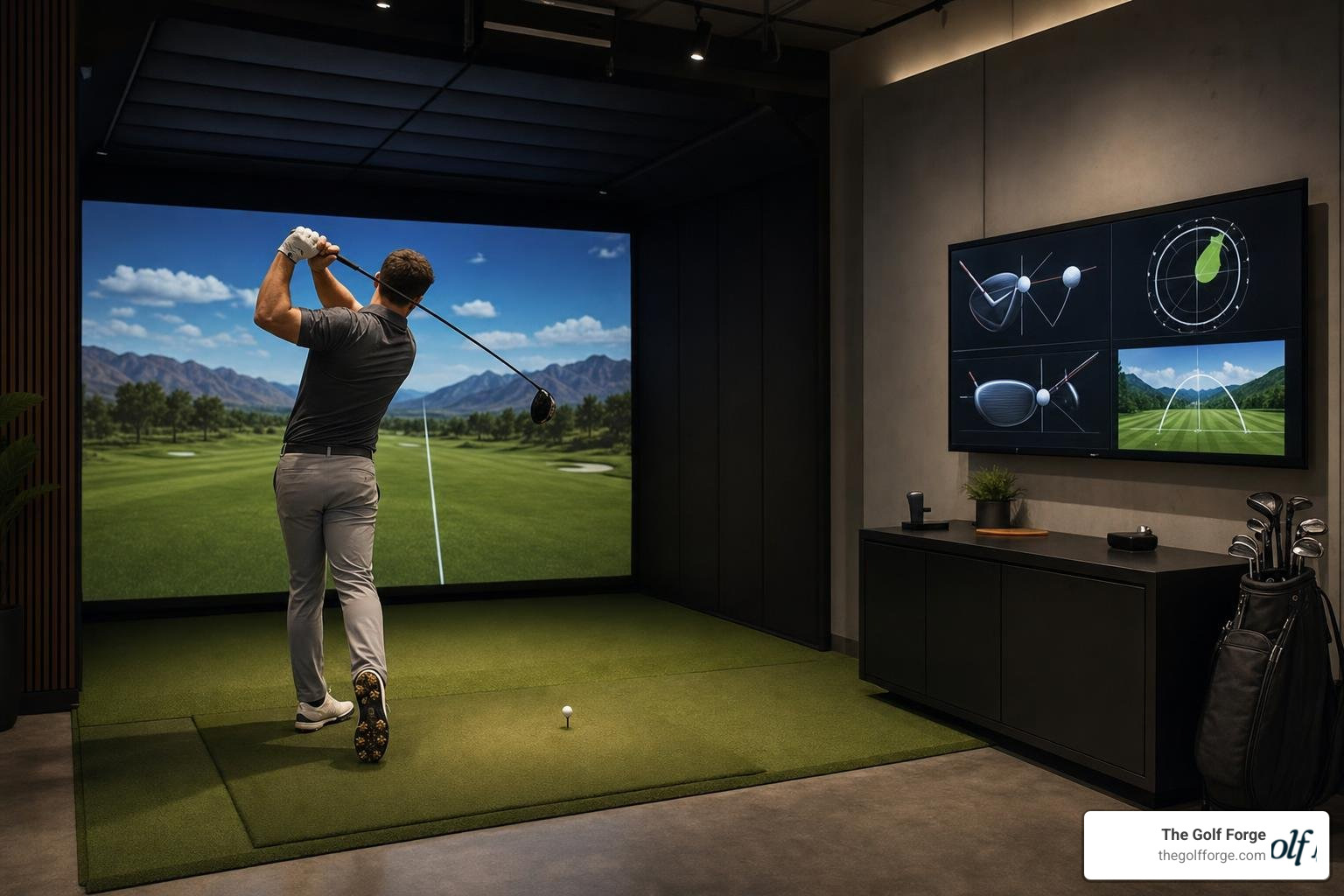
Using the advanced Foresight Falcon launch monitors at The Golf Forge, you can track over 40 precise data points on every single swing. This includes club path, face angle, angle of attack, spin loft, and exact carry distance.
Dialing in Your Yardages and Spin Rates
The first step in your indoor testing checklist is building a highly precise yardage matrix. You must know exactly how far each club carries in the air—rollout is highly unpredictable on the course, so carry distance is your golden metric.
During your golf simulator experience, focus on optimizing your spin loft and launch angles. For example, your driver should launch high with low spin (ideally between 2,000 and 2,500 RPM) to maximize carry and rollout. Conversely, your wedges need high spin to stop on a dime. If your clubs aren't hitting these windows, it's time to adjust your loft, lie, or shaft profile.
Analyzing Swing Path and Face Angle
The margin of error for a scratch golfer is razor-thin. A clubface that is open or closed by just 1.5 degrees at impact can mean the difference between a tight draw and a missed green.
By booking a private golf bay rental at The Golf Forge, you can monitor your club face control in real-time. If you notice your swing path is consistently in-to-out but your ball is pushing right, the launch monitor will show you exactly how many degrees your face was open relative to your path. This level of immediate, visual feedback is the fastest way to build a reliable, repeatable swing.
How Indoor Practice Accelerates Your Journey to Scratch
Practicing outdoors has its place, but as a training environment, the traditional driving range has major limitations. Wind, temperature, uneven mats, and poor-quality range balls make it incredibly difficult to isolate variables and truly understand your swing.
Indoor practice in our private, climate-controlled bays removes all external noise. You can practice in short sleeves while it's snowing outside in South Jordan, focusing entirely on your mechanics and numbers.
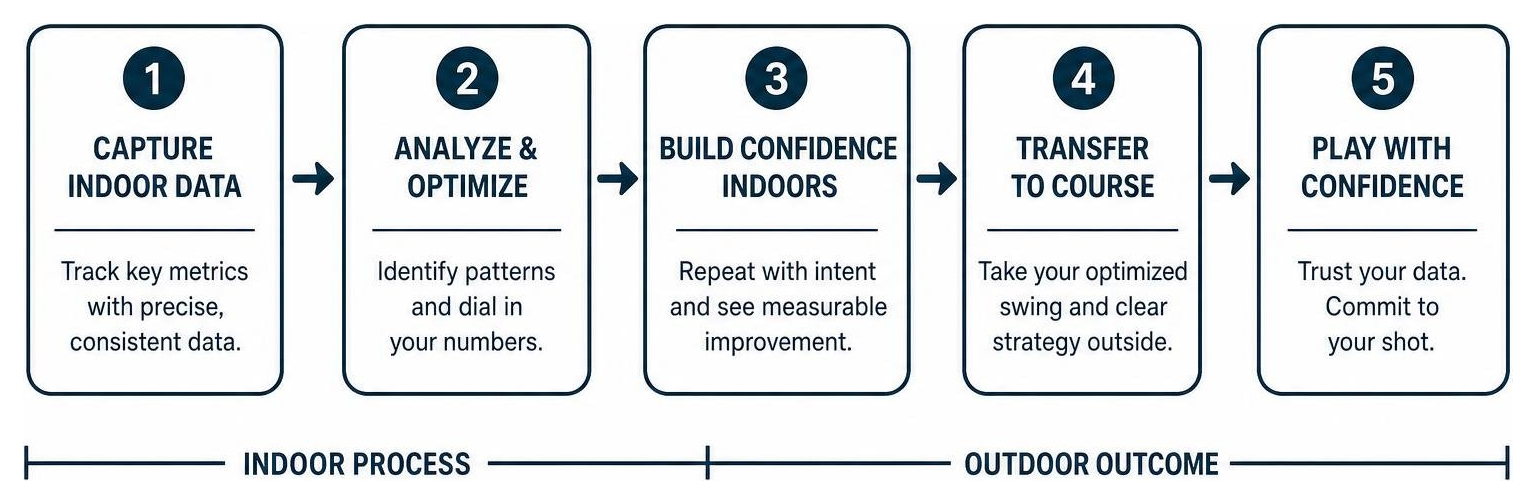
Here is a quick look at how training in a premium indoor simulator compares to a traditional outdoor range:
Feature Traditional Outdoor Range The Golf Forge Simulator Bays Weather Impact Subject to wind, rain, snow, and extreme heat 100% climate-controlled, perfect conditions Data Feedback Visual tracking only (highly subjective) 40+ data points (Foresight Falcon precision) Practice Hours Limited by daylight and staff hours 24/7/365 keyless app access for members Ball Quality Worn, limited-flight range balls Premium, real-world golf balls Distractions Loud adjacent bays, wind noise Private, distraction-free environment
While playing a beautiful local course like HOME - Glenmoor Golf Club Utah is the ultimate way to test your skills under pressure, building the mechanical consistency required to score well on those fairways is best accomplished in a controlled indoor setting.
Working with a Professional Swing Coach
Even the best technology is only as good as your ability to interpret it. That is why combining high-tech launch monitor data with the guidance of an expert swing coach is so powerful.
Instead of guessing what a "steep swing" feels like, our coaches can show you your exact angle of attack on screen and prescribe real-time drills to flatten it out. Whether you are trying to break 80 or fine-tune your game to reach a true scratch handicap, our golf swing coach guide 2026 outlines how structured, professional lessons can rapidly accelerate your progress.
Leveraging Tour-Level Launch Monitor Technology
At The Golf Forge, we don't believe in guessing. Our facilities are equipped with the overhead Foresight Falcon launch monitor system, offering unmatched accuracy.
Unlike basic camera systems or entry-level radars that struggle with indoor spin calculations, the Foresight Falcon uses high-speed quad-scopic cameras to measure the ball's exact launch characteristics directly off the face. It acts as a highly accurate golf simulator solver for your swing, giving you the same tour-level precision that the world's best players rely on to dial in their gear.
Frequently Asked Questions About Scratch Golf
What handicap is a scratch golfer?
A scratch golfer is defined as a player who can play to a course handicap of zero. This means they consistently shoot around par (or even under par) depending on the slope and rating of the course they are playing.
Can game-improvement irons be used by a scratch golfer?
While some low-handicap players use "player's distance" irons or combo sets that offer a bit of cavity-back forgiveness in their long irons, pure game-improvement irons are rarely used by scratch players. Game-improvement clubs are designed with high offset and wide soles to prevent slices and get the ball airborne, which limits a scratch golfer's ability to control their trajectory and shape their shots.
How does indoor simulator data help lower your handicap?
Indoor simulator data eliminates the guesswork from your practice. By knowing your exact numbers—such as spin rate, club path, and face angle—you can identify and correct swing flaws immediately. If you are looking to dial in your game in Salt Lake County, practicing at a premium golf simulator south jordan facility allows you to build a highly repeatable, data-proven swing that translates directly to lower scores on the course.
Conclusion: Take Your Game to Scratch at The Golf Forge
Achieving a scratch handicap requires dedication, the right equipment, and an environment that allows you to practice with absolute precision. You can't reach scratch by hitting worn-out range balls into a crosswind once a week. You need a dedicated space where you can analyze every detail of your swing, year-round.
At The Golf Forge, we provide the ultimate training ground for serious golfers in Utah. With convenient locations in South Jordan and West Jordan, our private bays are open 24/7/365 to members. Equipped with industry-leading Foresight Falcon technology, our bays offer the perfect environment to test your scratch golf club setup, work with a professional coach, or simply dial in your yardages.
We offer flexible membership tiers tailored to your lifestyle:
Bronze Membership: Perfect for casual practice and maintaining swing consistency.
Silver & Gold Memberships: Designed for dedicated players who want regular, high-frequency access to premium data and private bays.
Corporate Memberships: An exceptional option for business owners looking to entertain clients, foster team-building, or offer premium wellness perks to their employees with 24/7 flexibility.
Stop letting bad weather and inconsistent practice hold your game back. Ready to start your journey to scratch? Check out More info about our services to explore our membership options, book a private bay, or schedule a session with a swing coach today.