

The Step-by-Step Pathway to a More Consistent Golf Swing
Build a Golf Swing You Can Repeat
One shot flies straight. The next goes somewhere you didn't expect. When the weather or your schedule limits practice, it can be hard to work out what changed.
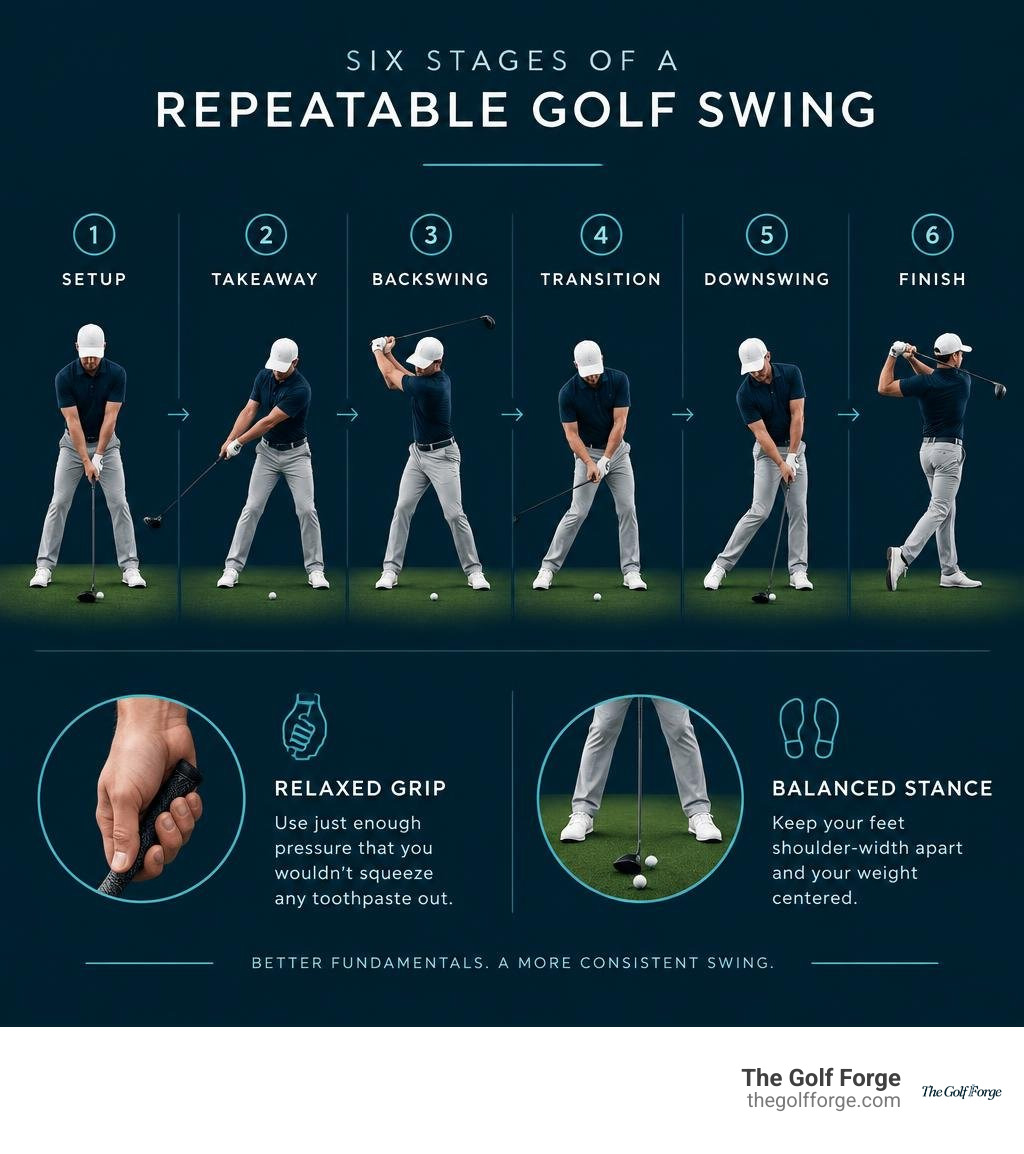
To improve your golf swing, start with a relaxed grip and balanced stance. Make a smooth turn back, shift toward your lead foot as you swing down, and finish without losing your balance. Practice one change at a time and check where the ball goes. At The Golf Forge, private 24/7 bays and Foresight Falcon launch monitor data let you do that on your schedule. Book practice time at our indoor studios in South Jordan or West Jordan, UT.
Core Mechanical Fundamentals to Better Your Golf Swing
Every repeatable golf swing relies on solid fundamentals established before the club ever leaves the turf. Attempting to compensate during the swing for a flawed starting position creates timing issues that break down under pressure.
Grip pressure is the first checkpoint. Many players squeeze the handle far too tightly, locking the wrists and forearms. A helpful way to calibrate your tension is the toothpaste tube test: hold the handle with just enough pressure that you wouldn't squeeze any toothpaste out.
To achieve a neutral grip, position the club diagonally across the fingers of your lead hand rather than across the palm. When looking down, you should see two to three knuckles, and the "V" formed by your thumb and index finger should point toward your trail shoulder. Your trail hand fits snugly against the lead hand—whether you choose an interlocking or overlapping style—with its "V" running parallel to the first.

Alignment dictates your club path and swing plane. Laying down two alignment sticks during range sessions—one parallel to your target line for your feet and shoulders, and another perpendicular for ball position—ensures you aim correctly. Combining these static checks with structured golf swing improvement helps eliminate compensations before you start your backswing.
Dynamic Setup and Posture Adjustments to Better Your Golf Swing
A modern golf setup is dynamic rather than rigid. Instead of slouching from the shoulders or locking your knees, hinge forward directly from your hip joints while keeping your spine naturally straight.
Your weight distribution sets up your balance. For iron shots, distribute your weight roughly 50/50 between your feet, or bias 55% toward your lead side to encourage a crisp, downward strike. With a driver, set roughly 55% to 60% of your weight on your trail side to promote an upward angle of attack.
Setup Component | Common Static Fault | Dynamic Posture Correction |
|---|---|---|
Spine & Hips | Bending at the waist with rounded shoulders | Hinge deeply from the hip joints with a flat, neutral spine |
Knee Flex | Locking knees or squatting too low | Soft, athletic flex with knees aligned over the balls of the feet |
Weight Distribution | Sitting back entirely on the heels | Centered over the midfoot/balls of the feet with 50-55% lead bias for irons |
Arm Hang | Reaching excessively toward the ball | Letting arms hang naturally and relaxed straight down from shoulders |
Takeaway, Transition, and Tempo Synchronization
The takeaway sets the swing in motion. Initiate this movement with your chest and shoulders working together in a one-piece takeaway. For the first two to three feet, the clubhead should remain outside your hands while the clubface matches your spine angle. Avoid rolling your wrists open, which pushes the club too far behind you.
As your shoulders rotate 90 degrees and your hips turn roughly 45 degrees, synchronization is key. Tour data shows that an ideal swing tempo ratio is roughly 3:1—meaning the backswing takes roughly three times longer than the downswing.
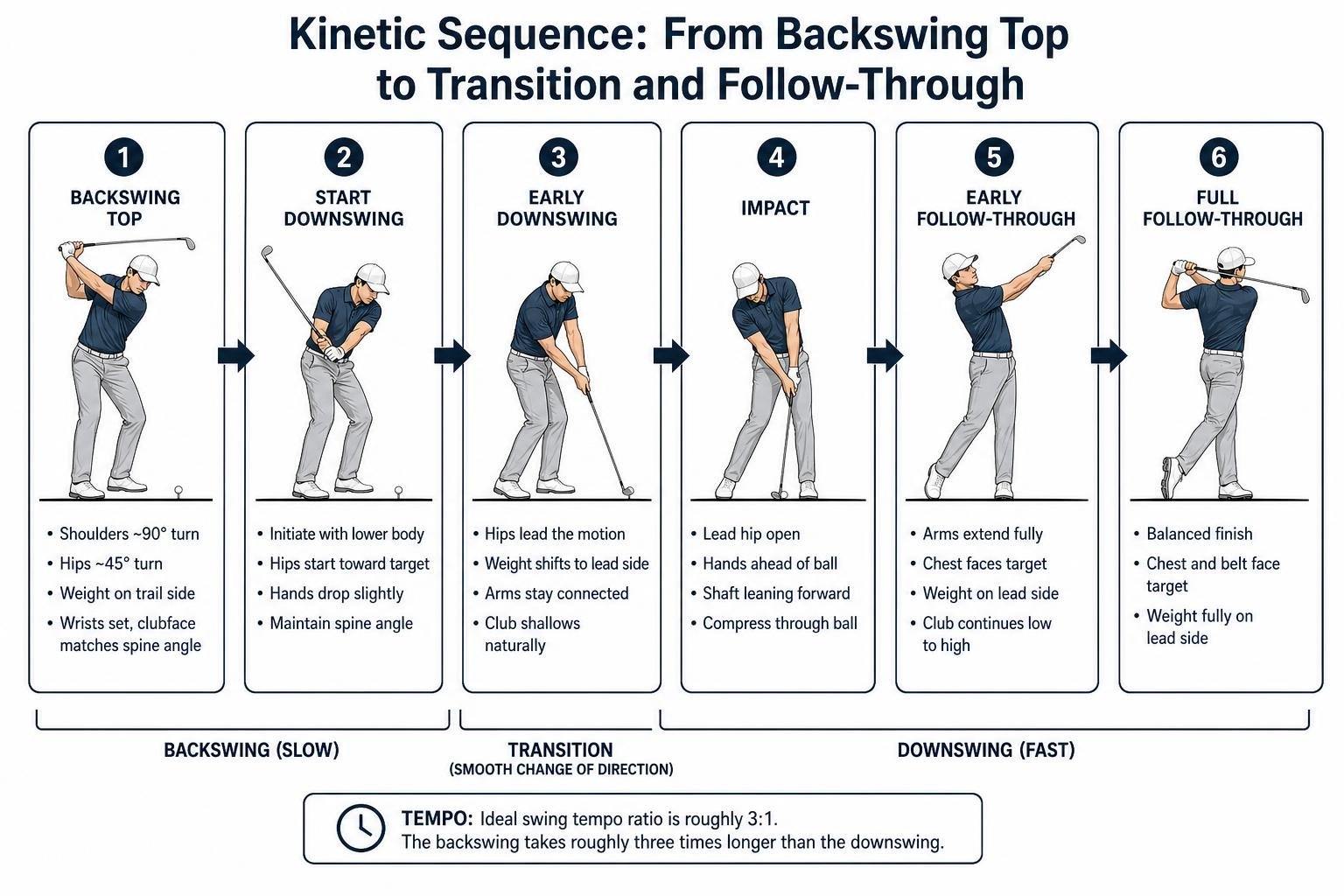
Integrating dedicated golf swing tempo training prevents the rushed transition that causes slices and hooks. Rushing the top of the swing throws the arms off-plane; a smooth change of direction gives the clubhead time to shallow naturally.
Sequencing the Downswing and Impact to Better Your Golf Swing
A tour player's downswing lasts approximately 0.25 seconds—quicker than the brain can process conscious instructions. Because of this speed, you must rely on proper kinematic sequencing rather than mid-swing adjustments.
The downswing starts from the ground up:
The lower body initiates the transition by shifting pressure toward the lead heel.
The hips rotate open, pulling the torso into rotation.
The shoulders uncoil, dropping the arms into the slot.
The hands and wrists deliver the clubhead through impact.
To produce compressed ball striking, your lead wrist should remain relatively flat or slightly bowed at impact. This controls the clubface and delivers forward shaft lean, ensuring the club strikes the ball first before taking a shallow divot. Using detailed golf swing plane analysis allows you to check whether your club path delivers clean, square contact.
Physical Mobility and Balance Training for Swing Control
Your swing cannot move through ranges of motion your body cannot physically support. Limited mobility in the hips or thoracic spine forces your body to stand up early or sway off the golf ball, producing erratic strikes.

To build rotational mobility, incorporate targeted stretching into your routine:
90/90 Hip Stretch: Sit on the floor with both knees bent at 90-degree angles to target internal and external hip rotation.
Thoracic Spine Openers: Kneel and rotate your upper torso toward the sky to increase your shoulder turn without compromising spine angle.
Single-Leg Balance Swings: Practice swinging with your trail foot resting lightly on its toe to train dynamic balance and ground-force transfer.
For a comprehensive workout routine, refer to this physical conditioning guide for golfers to build the core stability and mobility required for a repeatable motion.
Data-Driven Practice and Swing Feedback Technology
Practicing without feedback often reinforces the exact flaws you are trying to fix. The human brain perceives swing feel differently from what occurs in reality. You might feel like you are shallowing the club, while video analysis reveals you are still swinging over the top.
Modern launch monitor technology bridges the gap between feel and real by tracking:
Club Path & Face Angle: Measuring face-to-path ratios to diagnose ball curvature.
Angle of Attack: Ensuring you hit down on irons and sweep up on the driver.
Ball Speed & Launch Angle: Verifying energy transfer and strike efficiency.
Using high-resolution cameras and overhead tracking inside a controlled environment gives you immediate, objective metrics on every repetition. Training inside an indoor golf training facility removes wind and bad weather, letting you isolate swing mechanics with reliable feedback.
Structuring Practice Sessions for On-Course Transfer
Most amateurs miss the green on 10 to 12 holes per round. If you can get up and down half the time, you save five to six strokes every round. Transferring swing improvements from practice to the course requires structured session design.
Split your practice into two phases:
Block Practice (Technical Calibration): Focus on a single mechanical feel or checkpoint. Hit 10 balls with one club, checking club delivery and posture.
Random Practice (Course Simulation): Switch clubs and targets on every swing. Never hit the same club twice in a row. Go through your complete 15-to-20-second pre-shot routine to simulate competition conditions.
Using the 10-ball rule—where you must execute 10 consecutive shots within an acceptable target window before changing drills—trains focus under pressure. Applying these principles during golf simulator practice helps you play simulated rounds and track real performance under course conditions.
Equipment Optimization and Custom Club Fitting
Even a mechanically sound swing will struggle if your clubs work against your natural delivery. Playing off-the-rack clubs with incorrect shaft weight or lie angles causes subtle compensations that derail consistency.
Shaft Weight & Flex: A shaft that is too light leads to erratic timing and handsy flips at impact. Increasing shaft weight by 10 to 15 grams can improve center-strike consistency and path stability.
Lie Angle: If a club is too upright, the heel digs in, sending the ball left of target. If it is too flat, the toe strikes first, pushing shots to the right.
Loft & Face Angle: Optimizing launch angles and spin rates maximizes carry distance and improves control into greens.
Frequently Asked Questions About Swing Improvement
How long does it take to build a repeatable golf swing?
Building a consistent swing generally takes 8 to 12 weeks of deliberate, structured practice. Progress depends on practice quality rather than sheer ball count. Using instant video or launch monitor feedback speeds up motor learning and prevents bad habits from taking root.
What is the most effective tempo ratio for full swings?
Biomechanical analysis shows that the ideal full-swing tempo ratio is 3:1. The backswing takes roughly three times longer than the downswing. This timing promotes a smooth transition and allows the club to shallow properly before accelerating through impact.
How do launch monitors accelerate swing correction?
Launch monitors measure precise impact metrics—including club path, face angle, impact location, and launch parameters—that the naked eye cannot see. By revealing the exact cause of errant ball flight, data-driven tools remove guesswork. You can further accelerate your progress by working with a golf coach on your swing to interpret the data and target the right drills.
Conclusion
Developing a consistent, repeatable golf swing requires an intentional approach: master your address fundamentals, sequence your downswing using ground forces, improve your rotational mobility, and validate every adjustment with objective data. Deliberate practice with real-time feedback is the fastest way to turn technical changes into natural habits on the golf course.
At The Golf Forge, our private 24/7 bays feature advanced Foresight Falcon launch monitors to give you accurate club and ball tracking on every swing. Whether you are practicing in our weather-proof studios or working with a dedicated swing coach, we provide the tools you need to take control of your game. Book a practice session or explore our flexible membership options—including Bronze, Silver, Gold, and Corporate plans—at our South Jordan and West Jordan, UT locations today.