

Why You Quit on Your Swing: Step-by-Step Drills to Nail Your Follow-Through
Why Your Follow-Through Dictates Impact and Ball Flight
If you find yourself lurching off balance after impact, flipping your wrists, or watching shots slice weakly down the fairway, you are likely quitting on your swing before striking the ball. To quickly fix your finish, use targeted drills to improve follow-through in golf: practice L-to-L half-swings to enforce proper arm extension and wrist rehinging, tuck a towel across your chest to maintain upper-body connection, and use the Finish to the Wall drill to drive 90% of your weight into your lead heel.
At The Golf Forge in South Jordan and West Jordan, Utah, golfers use private 24/7 bays and Foresight Falcon launch monitor data to diagnose exactly why their follow-through breaks down and rebuild it with swing coach access and structured feedback. Before breaking down specific drill work, you need to understand why the finish is so tightly linked to impact quality.

A common misconception among amateur golfers is that the follow-through does not matter because the ball has already left the clubface. In reality, the golf swing is a continuous kinetic chain. You cannot stop your swing or steer your mechanics at impact without actively decelerating before striking the golf ball. Your finish is the direct physical footprint of everything that happened in the split second before impact.
Physics dictates that roughly 80% of a shot's starting direction is determined by the clubface angle at impact, which is heavily managed by how your arms, forearms, and wrists rotate through the hitting zone. If you decelerate or tense up through impact, the clubface twists, adding erratic spin that sends shots slicing or hooking across the fairway.
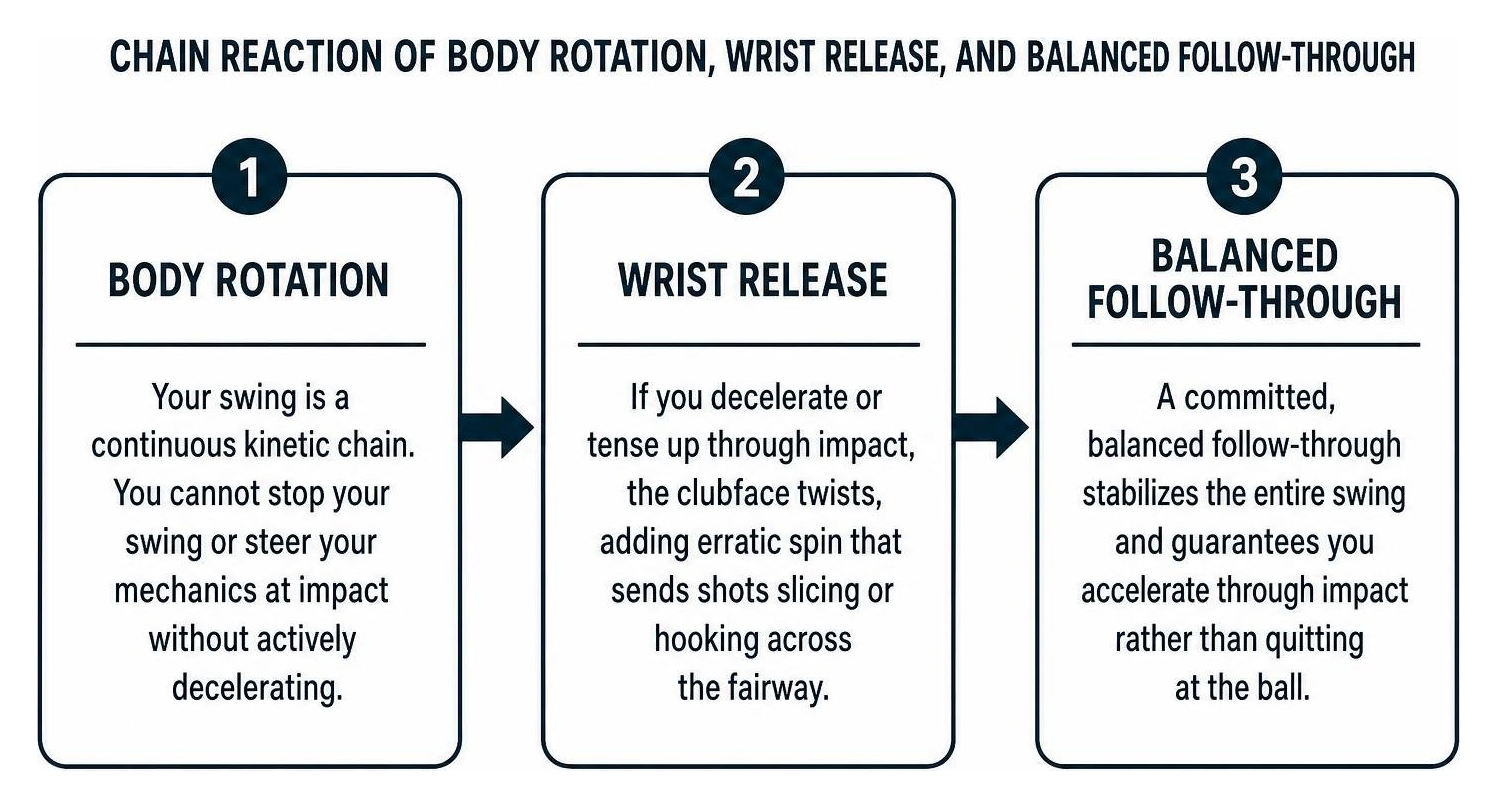
When golfers pursue golf swing improvement, studying elite ball-strikers reveals how a committed finish stabilizes the entire swing. For example, professional-level analysis demonstrates that controlling the exit path and keeping the upper body centered produces a consistent face-to-path relationship of around -2 degrees, which is the sweet spot for a reliable, tight draw. A committed, balanced follow-through guarantees you accelerate through impact rather than quitting at the ball.
Swing Phase Checkpoint | Balanced, Tour-Level Follow-Through | Flawed / Collapsed Follow-Through |
|---|---|---|
Weight Distribution | 90%+ weight anchored firmly in lead heel | Weight hanging back on the trail foot |
Torso & Hips | Belt buckle and chest fully facing the target | Hips stall early; chest remains open to the ball |
Lead Arm Structure | Extended, soft fold upward into natural finish | "Chicken wing" bend with elbow pulling outward |
Trail Foot | Perfectly vertical on the tip of the trail toe | Flat-footed or dragging along the turf |
Balance Hold | Capable of holding finish pose for 3+ seconds | Stumbling backward, falling toward toes, or losing posture |
Anatomical Checkpoints of a Tour-Level Finish
To evaluate whether your finish is functioning properly, you should look for specific physical checkpoints once your swing stops:
Lead-Side Ground Force Transfer: At least 90% of your body weight must finish on the outside heel of your lead foot, creating a solid post to rotate around.
Vertical Trail Foot: Your trail foot should be pulled completely up onto the tip of the toe, with the sole facing directly behind you.
Target-Facing Belt Buckle: Your hips must fully clear so your belt buckle points directly at the target, if not slightly left of it (for a right-handed player).
Proud Chest Posture: Maintain your spine angle without collapsing downward. Your chest should feel tall and proud, rotated past the target line.
Effortless Balance: You should be able to hold your finish pose effortlessly for three full seconds, just like a gymnast sticking a landing.
Step-by-Step Drills to Improve Follow Through in Golf
To correct a faulty follow-through, you must train your muscles using focused, progressive movements. Whether you are hitting balls outside or practicing indoor follow-through drills for better contact, these exercises build dynamic muscle memory by breaking the swing down into manageable checkpoints.
The L-to-L Drill for Arm Extension and Rehinging
The L-to-L drill is one of the most reliable exercises for eliminating early arm collapse and developing proper wrist action.
Set Up: Take an 8-iron or 9-iron and assume your normal posture.
Backswing L (9 O'Clock): Make a smooth half backswing until the shaft is parallel to the ground and your lead arm is horizontal, creating a 90-degree "L" shape with the club shaft pointing straight up.
Rotate and Release (3 O'Clock): Swing through the impact zone by rotating your core. Keep your lead arm extended as you push through the hitting area.
Finish L (3 O'Clock): Allow your wrists to naturally rehinge upward so the club creates a mirror-image "L" shape on the follow-through side, with the shaft pointing toward the sky.
Progression: Start at 50% speed. Once you consistently produce clean strikes, expand your finish into a full swing while retaining that natural wrist-led rehinge. You can review detailed variations of the L-to-L drill to eliminate the chicken wing to master the sequencing.
The Towel Under Arms Drill for Torso Connection
When your arms disconnect from your core, you lose low-point control and invite weak slices. The towel under arms drill is a classic training technique that teaches your upper body and arms to move as one unit.
Towel Placement: Tuck a standard golf towel across your chest, pinching the ends securely under both armpits.
Half-Swing Rotation: Take 9-to-3 swings at 60% effort without letting the towel fall to the floor.
Targeted Variations: If you suffer from an over-the-top move, place the towel under only your trail arm to prevent the elbow from flaring out. If you fight a chicken wing, place the towel under only your lead arm to force your chest to pull the arm through.
Connection Feel: Notice how keeping the towel pinned forces your torso to clear, smoothing your swing path and improving your swing plane mechanics.
Core Body and Wrist Drills to Improve Follow Through in Golf Mechanics
Maintaining body tilt while rotating the forearms prevents you from standing up early through the shot.
Right-Tilt and Supination: Practice keeping your trail shoulder low through impact while allowing your lead forearm to supinate (rotate outward so the palm turns upward). Working on a right tilt and supination combination drill will help you coordinate side bend with natural forearm release.
The Follow-Through Wrist Bend Drill: Slicers often hold the clubface wide open through impact. To fix this, practice slow-motion swings where the toe of the club points straight up to the sky at waist-high follow-through. A targeted follow-through wrist bend drill ensures the wrists release properly rather than blocking the face open.
Fixing Common Follow-Through Faults with Targeted Exercises

Curing the Chicken Wing and Early Arm Collapse
A chicken wing occurs when the lead elbow bends outward and separates from the torso through impact. This usually happens because the golfer attempts to scoop the ball into the air or stops their hip rotation.
The Cause: Inactive wrists and stalled lower-body rotation force the elbows to absorb the clubhead's momentum.
The Fix: Use an impact bag or soft pillow. Practice swinging into the bag with a flat lead wrist, ensuring your chest keeps turning past the bag so your arms extend fully down the target line. Focus on feeling the clubhead work up due to wrist momentum rather than pulling your elbows apart.
Eliminating Slices and Blocks with Proper Forearm Rotation
When golfers drag the grip too far ahead of the clubhead without rotating their forearms, the face remains open, creating high, weak push-slices.
The Cause: Overactive, tense hands that "steer" the club rather than releasing it freely.
The Fix: Hit soft pitch shots where you deliberately let the trail hand roll gently over the lead hand past impact. At the waist-high follow-through position, the toe of your iron should point vertically or slightly closed. Once you feel this rotation, increase your swing speed gradually.
Correcting Hanging Back with the Finish to the Wall Drill
"Hanging back" or falling away from the target causes fat shots, thin strikes, and erratic hooks. The Finish to the Wall drill provides an immediate tactile cue to correct your weight transfer.
Setup: Stand without a club, positioning your lead hip roughly 4 to 6 inches away from an indoor wall.
Backswing Pivot: Turn your shoulders into a backswing position, loading weight into your trail heel.
Downswing Bump and Turn: Initiate the downswing by shifting your weight forward until your lead hip gently touches the wall.
Wall Tap Finish: Rotate through into a complete follow-through, finishing with your trail hand tapping the wall in front of you. This ensures your center of mass moves through the ball onto your lead leg.
Indoor Training Strategies for Mastering Your Finish Position
Refining your follow-through requires deliberate repetition without the distraction of watching where the ball lands on a driving range. Training in a controlled indoor environment allows you to isolate body mechanics and develop dynamic balance.

Using Indoor Drills to Improve Follow Through in Golf During Off-Season Training
Winter weather and poor course conditions often disrupt swing mechanics. Practicing indoor golf routines provides a dedicated environment to master body positioning.
Mirror Feedback: Position a full-length mirror face-on and down-the-line to confirm your checkpoints: vertical trail foot, proud chest, and level shoulders at the finish.
Slow-Motion Rehearsals: Practicing half-speed swings without a ball reinforces muscle memory, which is essential when learning how to practice golf in the winter.
Impact Line Discipline: Use alignment rods taped to the floor to ensure your hands and clubhead exit naturally to the left along the swing arc rather than pushing straight down the target line.
Leveraging Launch Monitor Data and Expert Coaching
While visual feedback from mirrors helps shape your swing, pairing drill work with launch-monitor ball flight numbers confirms that your mechanics produce real-world results. Participating in indoor golf training with advanced overhead launch monitors lets you monitor face-to-path angle, club delivery, and ball spin rates on every swing.
Working alongside a professional instructor for golf performance coaching accelerates this learning curve. An instructor can evaluate your golf swing tempo training, ensuring that you maintain acceleration through the ball rather than quitting early.
At The Golf Forge's facilities in South Jordan and West Jordan, Utah, golfers train in private 24/7 bays equipped with tour-proven Foresight Falcon launch monitors. This technology provides instantaneous, high-speed camera feedback on your club path, impact location, and exit dynamics.
Frequently Asked Questions about Golf Follow-Through Drills
Why does my follow-through collapse if impact has already occurred?
Your follow-through collapses because your brain anticipates deceleration before impact. If your body senses that your club path is off-line, your grip is too tight, or your weight is stuck on your trail foot, your nervous system applies the brakes just before striking the ball. Practicing full follow-through drills conditions your body to accelerate through the ball toward a balanced finish.
How do I stop quitting on my swing with the driver?
Quitting on a driver swing usually happens when golfers try to steer the ball onto the fairway or lift it into the air. To stop quitting on the driver:
Maintain continuous hip rotation through the hitting area.
Focus on swinging the clubhead toward a high, full finish behind your lead ear.
Trust the natural loft of the driver instead of trying to scoop the ball upward.
What is the difference between a follow-through drill for accuracy versus power?
Accuracy Drills: Emphasize a controlled, abbreviated finish (such as a 3/4 punch-shot follow-through) that minimizes excess wrist roll and keeps the clubface square to the swing path longer.
Power Drills: Focus on maximum core rotation, high arm extension, and a full, unrestricted release to maximize clubhead speed through the hitting zone.
Master Your Follow-Through at The Golf Forge
A balanced, powerful follow-through is the hallmark of a consistent golfer. By implementing the L-to-L drill, the towel connection drill, and the Finish to the Wall drill into your weekly routine, you will eliminate deceleration, clean up your clubface control, and hit more solid shots.
If you are ready to take the guesswork out of your practice, visit The Golf Forge in South Jordan and West Jordan, Utah. Our 24/7 private indoor simulator bays feature cutting-edge Foresight launch monitors that deliver instant data on your swing path, club delivery, and ball flight.
Whether you want to practice on your own schedule with our Bronze, Silver, Gold, or Corporate membership tiers, or schedule a private lesson with an experienced swing coach, The Golf Forge provides the perfect environment to refine your mechanics and elevate your game year-round.